

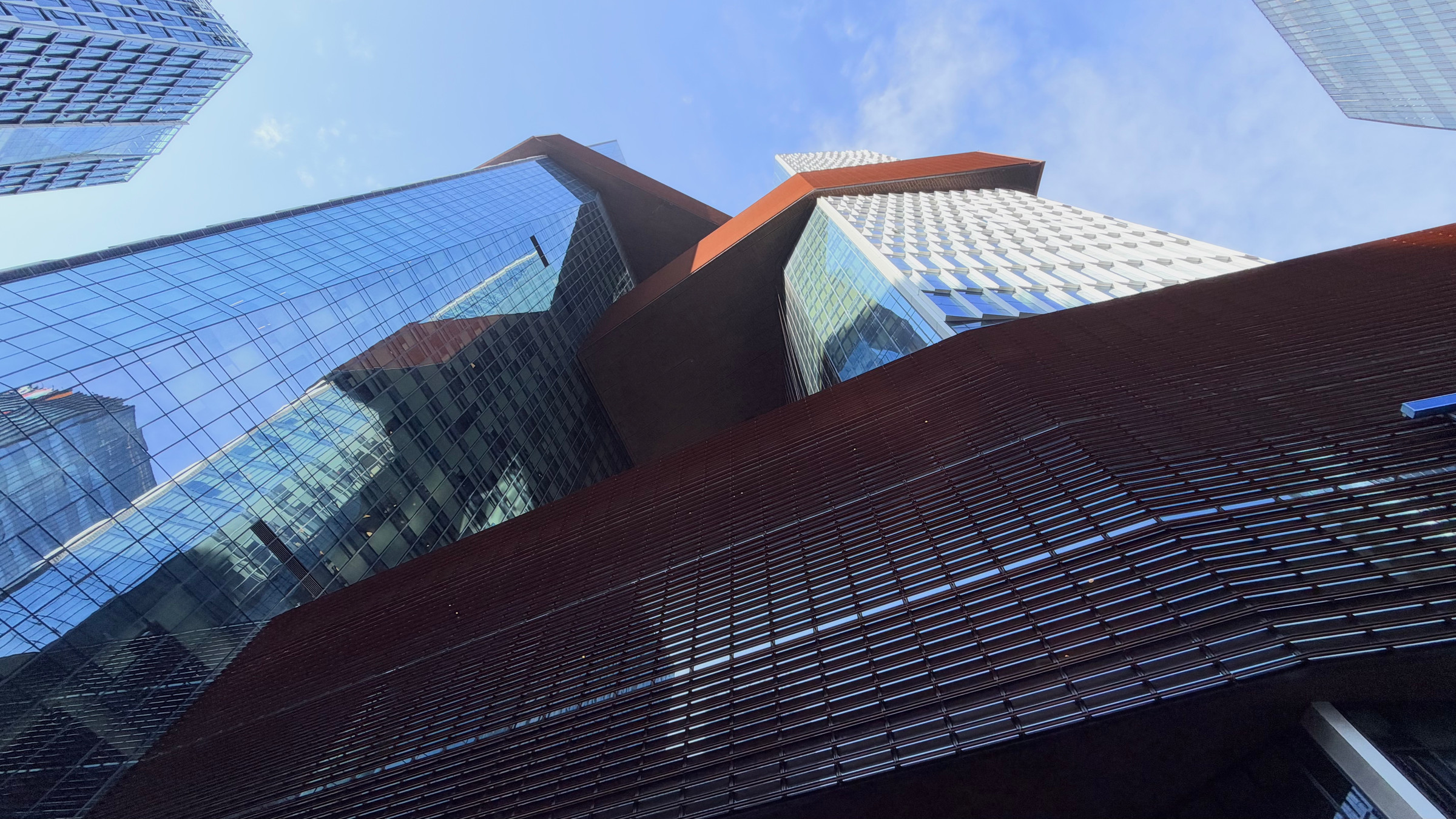
The first thing I photographed in Shenzhen was the Tencent Binhai towers from below, glass and an earthy volume meeting above Nanshan. I was there in the morning, with the Endeavor China Innovation Tour. Inside, the hall already put front and centre the AI infrastructure the company presents as its own, the Hy4 panel, an immersive room with the Tencent name over the city, the story of QQ, WeChat, a projected cave, a simulator and a Weixin Pay booth.
This piece brings two things together. One is what Tencent itself has published about the group, WeChat, the cloud and the Hy line. The other is what I saw in the Binhai hall, on the panels and in the rooms the company placed in front of the delegation. When a figure comes from an official release, I say so. When it comes from a hall panel, I say that too.
In the second quarter of 2026, Tencent reported revenue of RMB 204.8 billion, 11% above the same quarter of 2025, and capital expenditure of RMB 52.8 billion, 176% above a year earlier, according to the official results announcement. Revenue is growing. Spending on compute is growing much faster. Those two figures, and what the hall put on the walls, are what I used to organise what follows.
From Shenzhen, in 1998, to the Binhai campus
Tencent was founded in 1998, in Shenzhen, and its headquarters are still in the city. The company’s Our story page describes communication and social services that connect more than a billion people, alongside games, digital content, cloud, advertising, FinTech and enterprise services. The same page records the listing on the Hong Kong Stock Exchange in 2004.
The first product the public learned to recognise was QQ, the messenger launched in 1999. Weixin, known outside China as WeChat, arrived in January 2011. Weixin Pay arrived in August 2013. Weixin red packets, in 2014, according to the same official timeline. Also in 2014, that timeline records Tencent as one of the founders of WeBank. Mini Programs arrived in January 2017. In January 2018, combined monthly active users of Weixin and WeChat surpassed 1 billion, according to the company’s corporate overview. Video Accounts arrived in 2020. Mini Shops arrived in August 2024. Those milestones sit on the official timeline, and some of them also appear, in part, on the curved WeChat screen in the hall.
In September 2023, Tencent presented Hunyuan, its own foundation model. In May 2024, the Yuanbao assistant. In the 2025 results, the company was already talking about the HY 3.0 model and about products such as Yuanbao and WorkBuddy. In July 2026, according to the second quarter announcement, the production version of Hy3 came out. In August 2026, the Hy4 preview. In November 2026, Hy4 as the latest generation of the line.
Binhai, in Nanshan, is the place where that story is staged for anyone who walks in. It is the campus from which the company tells, at the same time, where it came from and where it is taking the operation.
The group's map
Anyone trying to explain Tencent from the outside runs into a long list of names: WeChat, Weixin, QQ, games, ads, payments, cloud, Hy, Yuanbao, WorkBuddy, CodeBuddy. The official second quarter 2026 results organise that machine into a few blocks, and that is the right place to start.
The RMB 204.8 billion of revenue in that quarter is divided, according to the same release, into three main lines and a residual. Value added services (VAS) came to RMB 98.4 billion, up 8% from a year earlier, and accounted for about 48% of revenue. Within that, domestic games brought in RMB 47.3 billion, up 17%, with a notable contribution, in the company’s text, from Delta Force, VALORANT on PC and mobile, and Roco Kingdom: World. International games brought in RMB 18.6 billion, 0.8% below a year earlier because of currency movements, or 4% higher in constant currency. Social networks, still inside VAS, brought in RMB 32.5 billion, up 0.8%.
Marketing services came to RMB 43.6 billion, up 22%, and accounted for about 21% of revenue. The release attributes that advance, among other factors, to the integration of marketing capabilities within the Weixin ecosystem, including Mini Games and Mini Shops.
FinTech and business services came to RMB 60.3 billion, up 9%, about 30% of revenue. FinTech growth, according to the company, came mainly from commercial payments, wealth management and consumer lending. Growth in business services came mainly from the cloud, with stronger demand for AI related services, international expansion and a more favourable pricing environment. The residual, which the release calls Others, was RMB 2.5 billion.
That quarterly cut is clearer against the full year. In the 2025 annual results, group revenue was RMB 751.8 billion, 14% above 2024. VAS came to RMB 369.3 billion, up 16%, with domestic games at RMB 164.2 billion and international games at RMB 77.4 billion; the company wrote that international games revenue surpassed US$10 billion that year. Marketing services came to RMB 145.0 billion, up 19%. FinTech and business services came to RMB 229.4 billion, up 8%. In that release, the company cites Honour of Kings and Peacekeeper Elite, alongside Delta Force, among the games that supported the domestic line, and attributes part of the marketing advance to closed loop ads that take the user into Mini Programs, Mini Shops or Mini Games. It also recorded that total time spent on Video Accounts grew more than 20% in 2025, and it reported growth of that order again in the second quarter of 2026.
There is one more line that the second quarter 2026 release treats separately: New AI Products, which, in the company’s note, mainly comprise Hy, Yuanbao, CodeBuddy, WorkBuddy and Xiaowei. They are not an accounting segment in their own right, at the same level as the three blocks above. They appear in the operating profit adjustment and in the discussion of spending on compute. In the hall, some of those names leave the footnote and become a screen: WorkBuddy occupies a whole set of panels; Yuanbao appears on a totem, next to WeChat.
That is the map I am using from here. WeChat organises the reach. Games and marketing pay a large part of the bill. FinTech and the cloud grow in the same block. The Hy line and the productivity tools try to lean on both ends, the user base and the infrastructure.
WeChat, Weixin and QQ
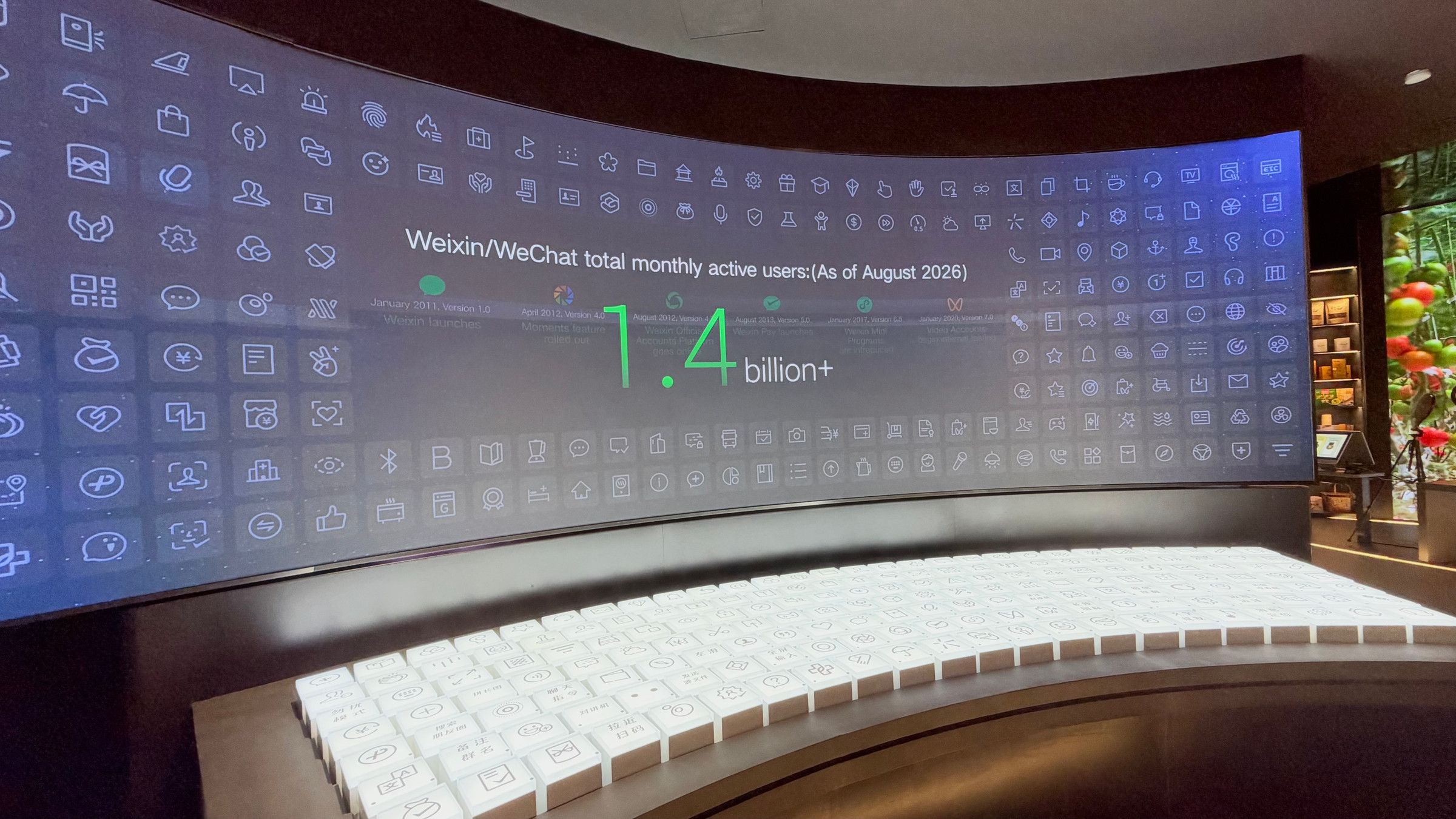
WeChat, or Weixin, is the centre around which the rest is organised. In the official second quarter 2026 results, combined monthly active accounts of Weixin and WeChat were 1.439 billion at the end of that quarter, 2% above a year earlier. In the hall, a curved screen at the centre of a room showed “Weixin/WeChat total monthly active users” and “1.4 billion+”, with the label “As of August 2026”. That August is the date of the metric on the panel, not the day of the visit. They are two snapshots of the same order of magnitude, in different months, both presented by the company. I do not add them together.
The same hall panel carried, in the background, a product timeline. I could read the launch of Weixin in January 2011, Weixin Pay in August 2013 and Mini Programs in January 2017, among other version marks. That matches what the official story page records.
Beside it, a Weixin Mini Programs panel announced, in its title, more than 100 countries and regions and more than 5 billion uses a year. I am staying with what the title states. The same panel carried other figures, broken out by quarter and by year, including 1.439 billion monthly active accounts of Weixin and WeChat in the second quarter of 2026, which matches the official operating metric for that quarter. I am not stacking every one of those lines here, and I am not mixing those quarterly figures with the “1.4 billion+” of August.
Another panel in the same block read “APEC in Action: Welcome to Shenzhen with Mini Programs at Your Fingertips”. There the company presented, among other points, translation in 26 languages and international card payments, and a path to access “Explore China” on WeChat.
The same 2025 results, and again the second quarter 2026 results, record that total time spent on Video Accounts grew more than 20% in a year. In the second quarter announcement, the company also writes that it has begun a small scale prototype test of Xiaowei, the agentic AI inside Weixin, with its own model called WeLM, built for user privacy, Weixin specific use cases and inference efficiency. I record that as what the company published in that quarter, not as a product I saw in the hall under that name.
QQ is the older layer of this story. In the official second quarter 2026 results, mobile device monthly active accounts of QQ were 520 million at the end of that quarter, 2% below a year earlier. At the end of 2025, the same metric was 508 million. In the hall, QQ does not appear as a number at the centre of the room. It appears as memory: the first generation penguin, a pager, a reconstructed internet café, a row of old phones. I come back to that when I describe the route.
The cloud in the hall and what the company reports
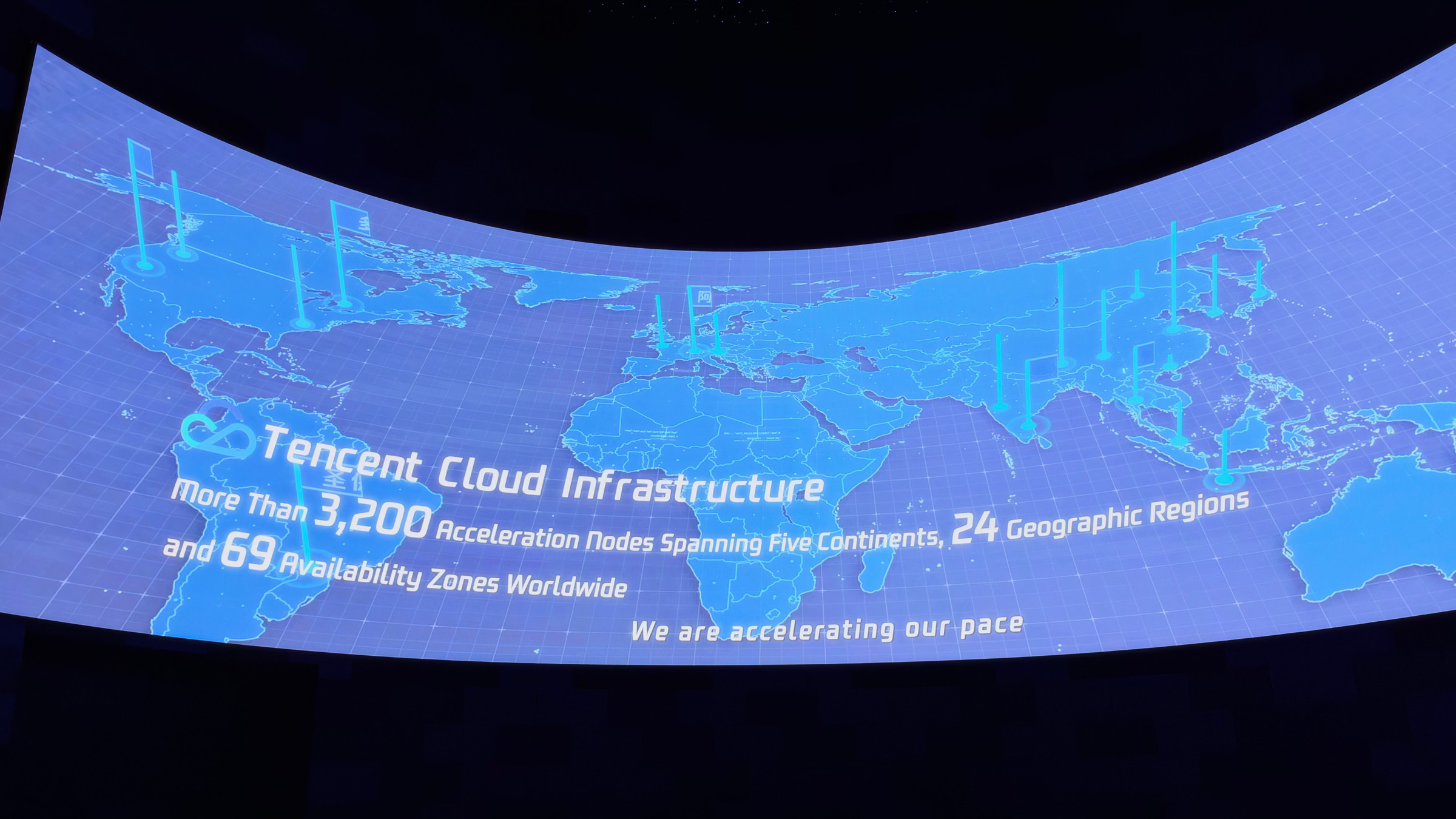
In the hall, Tencent Cloud Infrastructure occupied a curved screen with a map of the world: more than 3,200 acceleration nodes spanning five continents, 24 geographic regions and 69 availability zones worldwide, with the line “We are accelerating our pace”. Those are the figures on the panel the delegation saw during the visit. The cloud numbers I use when I talk about what I saw at Binhai are these.
In the 2025 annual results, the cloud already appeared as a driver inside FinTech and business services. The company wrote that business services revenue grew at a high teens rate, with domestic and international demand for cloud services, including AI related services, and with e-commerce technology service fees underpinned by Mini Shops GMV. In the same announcement, it said Tencent Cloud achieved profit at scale, with enterprise demand for AI workloads. In the second quarter of 2026, the cloud remains in that block. The company writes that growth in business services came mainly from cloud services, underpinned by stronger demand for AI related services, international expansion and a more favourable pricing environment. In the same text, when it explains cash flow, it refers to prepayments for compute to support the Hy line, WorkBuddy, CodeBuddy, Weixin AI initiatives and external demand for cloud services.
I do not treat the hall map and the results paragraph as if they were the same table. One is what was on the wall. The other is what the company reported to shareholders in that quarter.
The AI infrastructure and Hy4
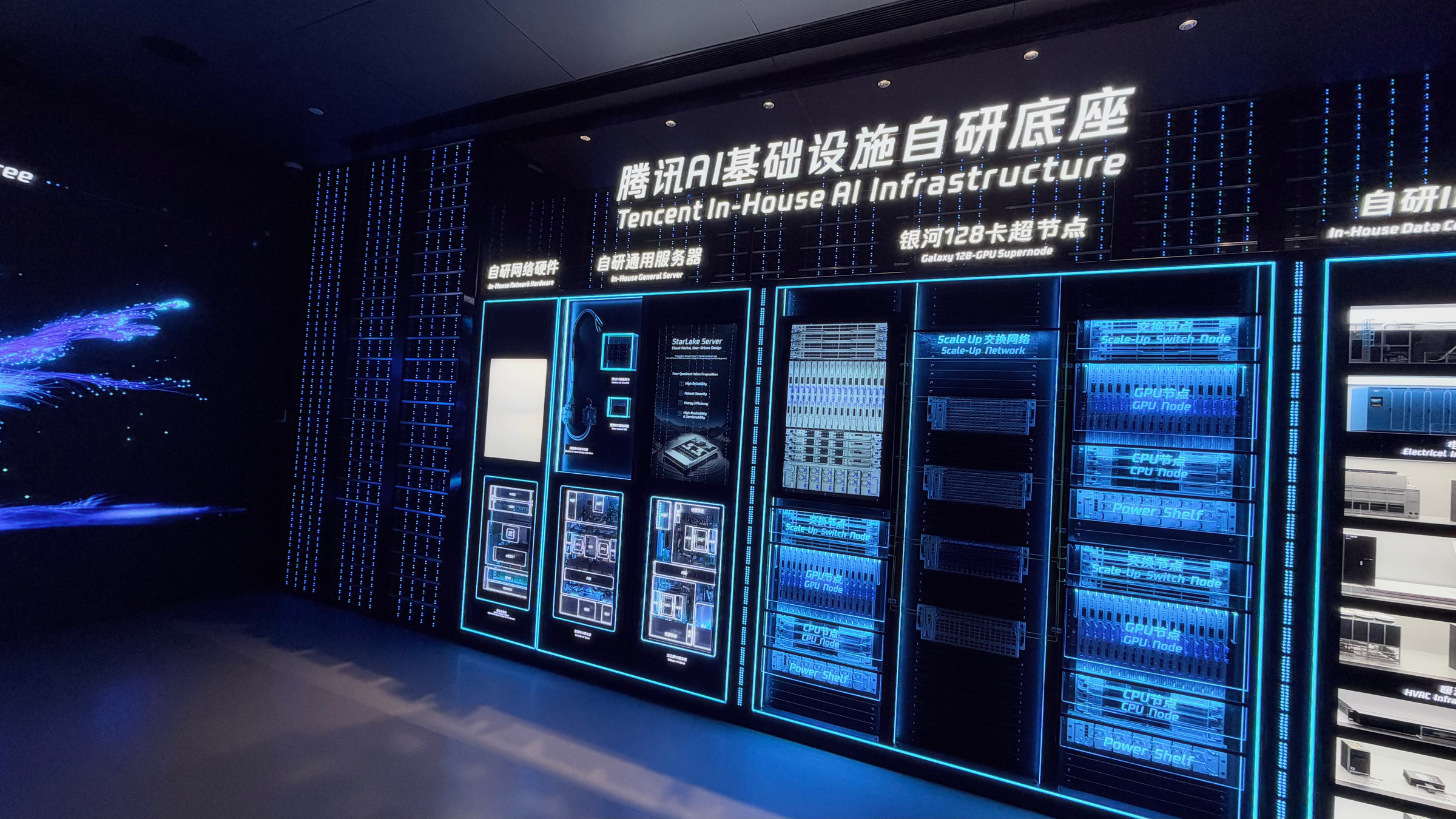
The technical base the hall presents begins on a wall inscribed 腾讯AI基础设施自研底座 / Tencent In-House AI Infrastructure, with the Galaxy 128-GPU Supernode, the racks and the network the company calls a Scale-Up Network. Up close, the rack column carries the names Scale-Up Switch Node, GPU Node, CPU Node and Power Shelf, repeated in bands of blue light.
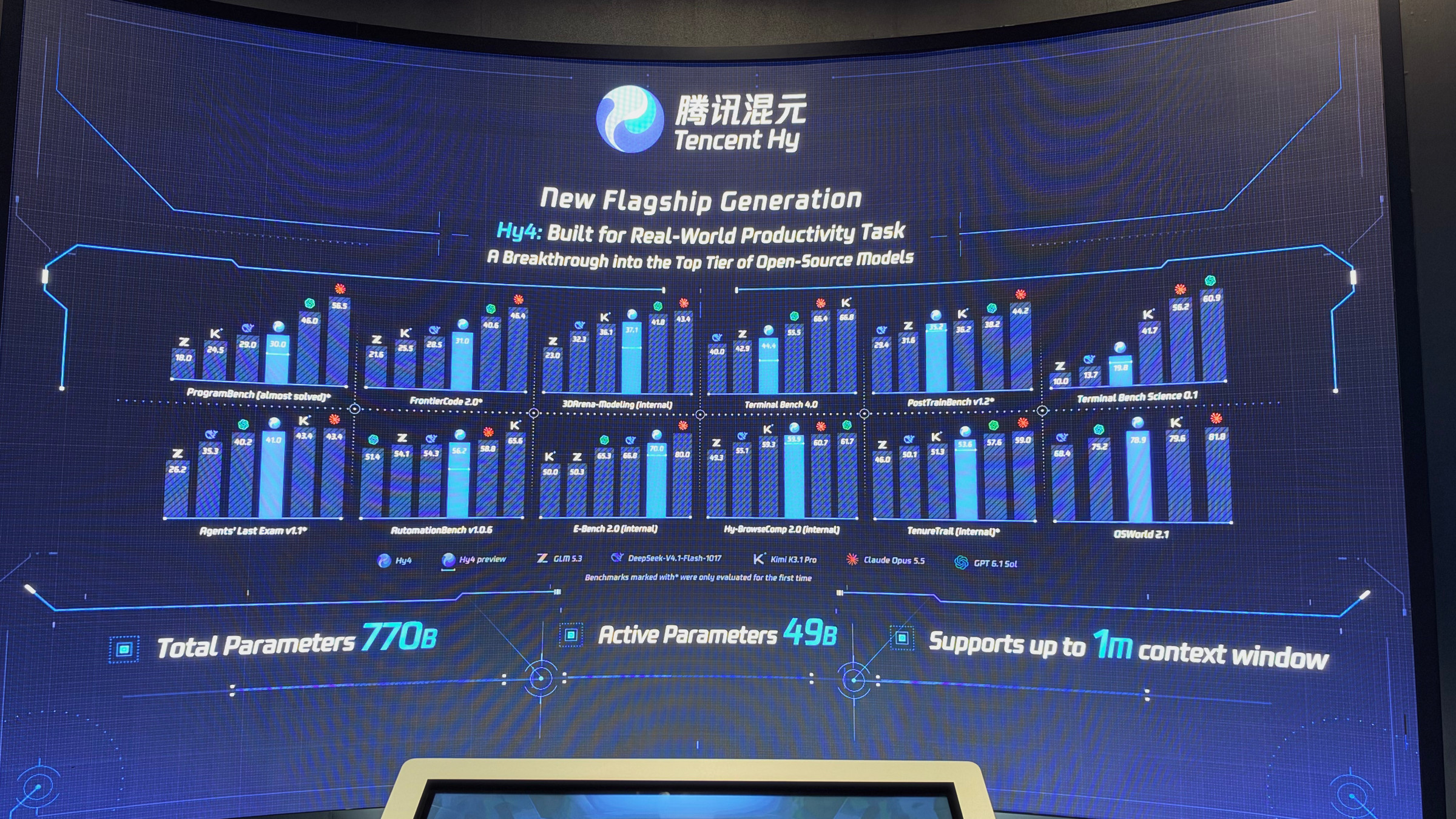
Further on, a curved 腾讯混元 / Tencent Hy panel presented Hy4 as a New Flagship Generation, with the line “Hy4: Built for Real-World Productivity Task”. At the foot of the same panel were the figures the company showed there: 770 billion total parameters, 49 billion active, and support for a context window of up to 1 million. There were also benchmark charts and the phrase “A Breakthrough into the Top Tier of Open-Source Models”. I record that as what was written in the hall, not as a verdict of my own.
Those three hall figures match what Tencent published in August 2026, in the Hy4 preview announcement: 770 billion total parameters, 49 billion active, and a context window of more than 1 million tokens. The word “tokens” is in the official preview announcement; on the hall panel, the text is “Supports up to 1m context window”, without that word. So when I talk about the hall, I stay with “a context window of up to 1 million”. When I talk about the announcement, I use the company’s wording.
In November 2026, Tencent announced Hy4 as the latest generation of the model. The official announcement describes, for the first time in this line, visual understanding and the ability to operate a computer, through a command line and a graphical interface. It also places Hy4 in products such as TokenHub on Tencent Cloud, WorkBuddy, CodeBuddy, Yuanbao and ima. In this piece, those points enter as what the company published. On this site, the pages for Hy4 and the Hy4 preview are already live.
In the hall, the productivity line appears in another way: WorkBuddy on a wall of dashboards, on a totem and on a grid of agents. Hy4, on the curved panel, is the model’s calling card. The infrastructure, in the racks, is what the company wants you to see behind it.
The bill: revenue, profit and the investment in compute
I come back to the official results, because the visit is clearer once you see the accounts that go with it, and the change of pace between 2025 and 2026.
In 2025, Tencent reported revenue of RMB 751.8 billion, up 14%, and gross profit of RMB 422.6 billion, up 21%. On a non-IFRS basis, the yardstick the company uses for what it treats as core earnings, operating profit was RMB 280.7 billion, up 18%, and net profit attributable to equity holders was RMB 259.6 billion, up 17%. On an IFRS basis, net profit attributable to equity holders was RMB 224.8 billion, up 16%. Capital expenditure that year was RMB 79.2 billion, only 3% above 2024. Free cash flow was still RMB 182.6 billion, up 18%. Total cash at the end of 2025 was RMB 494.9 billion, and the net cash position was RMB 107.1 billion.
In the first quarter of 2026, revenue was RMB 196.5 billion, up 9%, and capital expenditure rose to RMB 31.9 billion, 16% above a year earlier. Free cash flow was still positive, at RMB 56.7 billion, up 20%. In the second quarter, revenue reached RMB 204.8 billion, 11% above the same quarter of 2025 and 4% above the immediately preceding quarter. Gross profit was RMB 118.4 billion, up 13%. On a non-IFRS basis, operating profit was RMB 75.6 billion, up 9%, and net profit attributable to equity holders was RMB 68.4 billion, also up 9%. On an IFRS basis, operating profit was RMB 67.3 billion, up 12%, and net profit attributable to equity holders was RMB 56.0 billion, up 0.7%.
Capital expenditure in that second quarter was RMB 52.8 billion, 176% above a year earlier, a single quarter that already approaches the capital expenditure of the whole of 2025. Total cash was RMB 511.2 billion, up 9%. The net cash position was RMB 58.2 billion, 22% below a year earlier. Free cash flow was negative RMB 13.8 billion: operating cash of RMB 52.7 billion was more than offset by capital expenditure payments of RMB 59.3 billion, plus media content and lease payments. The company writes that those operating cash flows included substantial AI related prepayments for compute, and that, excluding those prepayments, free cash flow would have been RMB 37.6 billion.
There is another cut the second quarter release puts on the table. On a non-IFRS basis, operating profit excluding New AI Products was RMB 86.1 billion, up 19%. Reported operating profit, at RMB 75.6 billion, grows more slowly. The gap is the cost, in the accounts, of the new AI line. In the first quarter, the company had already presented a similar cut: operating profit of RMB 75.6 billion on a non-IFRS basis, and RMB 84.4 billion excluding the new AI products.
That is the yardstick I am taking from the visit, together with what was on the walls. In 2025, the operation still generated cash to spare, and capital spending was still growing only modestly. In 2026, the operation is still large, but a growing share of the cash, and an even larger share of the investment, is going into the compute that supports Hy, the office tools, Weixin and the cloud sold to third parties.
What I saw in Shenzhen
This was another stop on the Endeavor China Innovation Tour, after the Alibaba campus in Hangzhou and the XPeng campus in Guangzhou. At Binhai, what Tencent puts in the same hall is the app that organises daily life, payments, the memory of QQ, the cloud and the model.
The visit starts at the entrance, with the glass facade, and continues into the hall. The first projection that held me was a luminous blue tree, titled Tencent's Patents Tree. Soon after, or in the same block, a graph like visualisation in orange, green, blue and purple opened out the fields of that tree. The panel carried the label “As of June 2026”: 55,000 patents granted and 98,000 applications filed. The branches I could read safely were Cloud Computing, with more than 20,000; Artificial Intelligence, Security and Internet and Communications Standards, each with more than 10,000; Blockchain, with more than 9,000; and Engine & Rendering, with more than 6,000. To the right, the same panel recorded research and development investment of RMB 85.747 billion in 2025. Those are the panel’s figures, not figures from a report I checked separately.
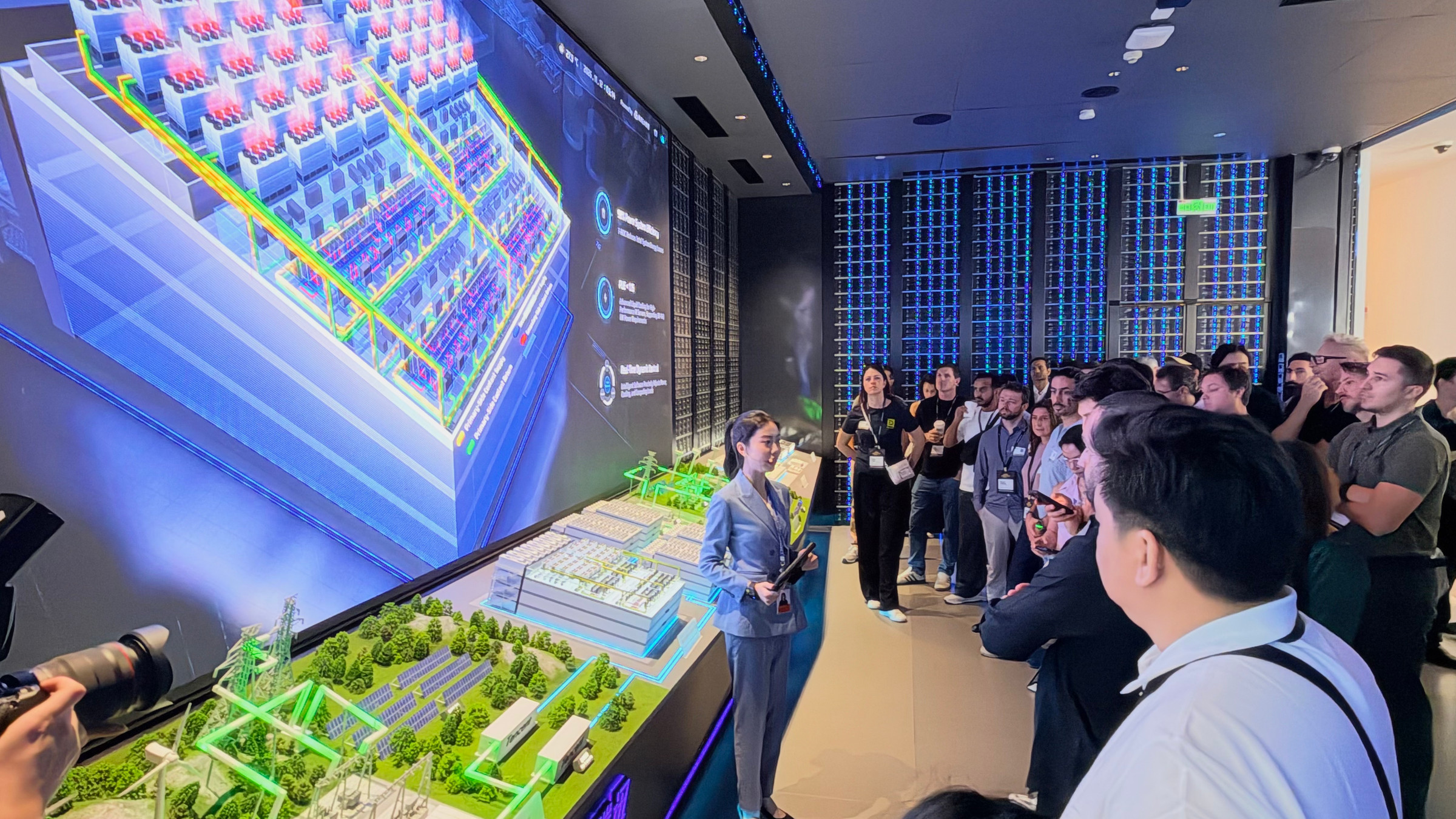
There was a model of the complex, with buildings, greenery and power infrastructure in front, and a huge screen behind it, showing a cutaway of the building and the racks. The guide, in a light blue suit, presented the model to the group. In the video of that moment, the Tencent name appears on the base of the model.
The Tencent In-House AI Infrastructure wall and the racks close up, with the Scale-Up Switch Node, the GPU Node, the CPU Node and the Power Shelf, sit in this early stretch of the route. The Hy4 panel, with the 770 billion, the 49 billion and the window of up to 1 million, comes next.
In a narrower recess, a vertical totem gathered smaller screens around a central Health Assistant display. On the surrounding screens, I could safely read WeChat, Yuanbao, WorkBuddy and Marvis. I am not inventing a full list: there were other icons whose names were not sharp enough in this frame.
Then came a room of operations panels: curved screens with the WorkBuddy interface, task lists and, on the right, a sales dashboard, with line charts and large numbers. In the centre, a low, organic, lit table. People from the group stood in front of the screens. I do not treat the numbers on that dashboard as Tencent’s results; it was a demonstration in the hall. A tighter photo of the same interface shows WorkBuddy again, with the menu for New Task, Assistant, Experts, Library and Discover.
The next wall was a grid of agent and app cards. The themes I could read at the top included e-commerce, content creation, investment analysis, legal consulting, small business and data analysis. Among the cards whose titles were legible were Senior Developer, WeChat Mini Program and Workspace Builder. I am not transcribing the whole grid: many names were cut off by the curve of the screen. On the left hand bar, once again, WorkBuddy.
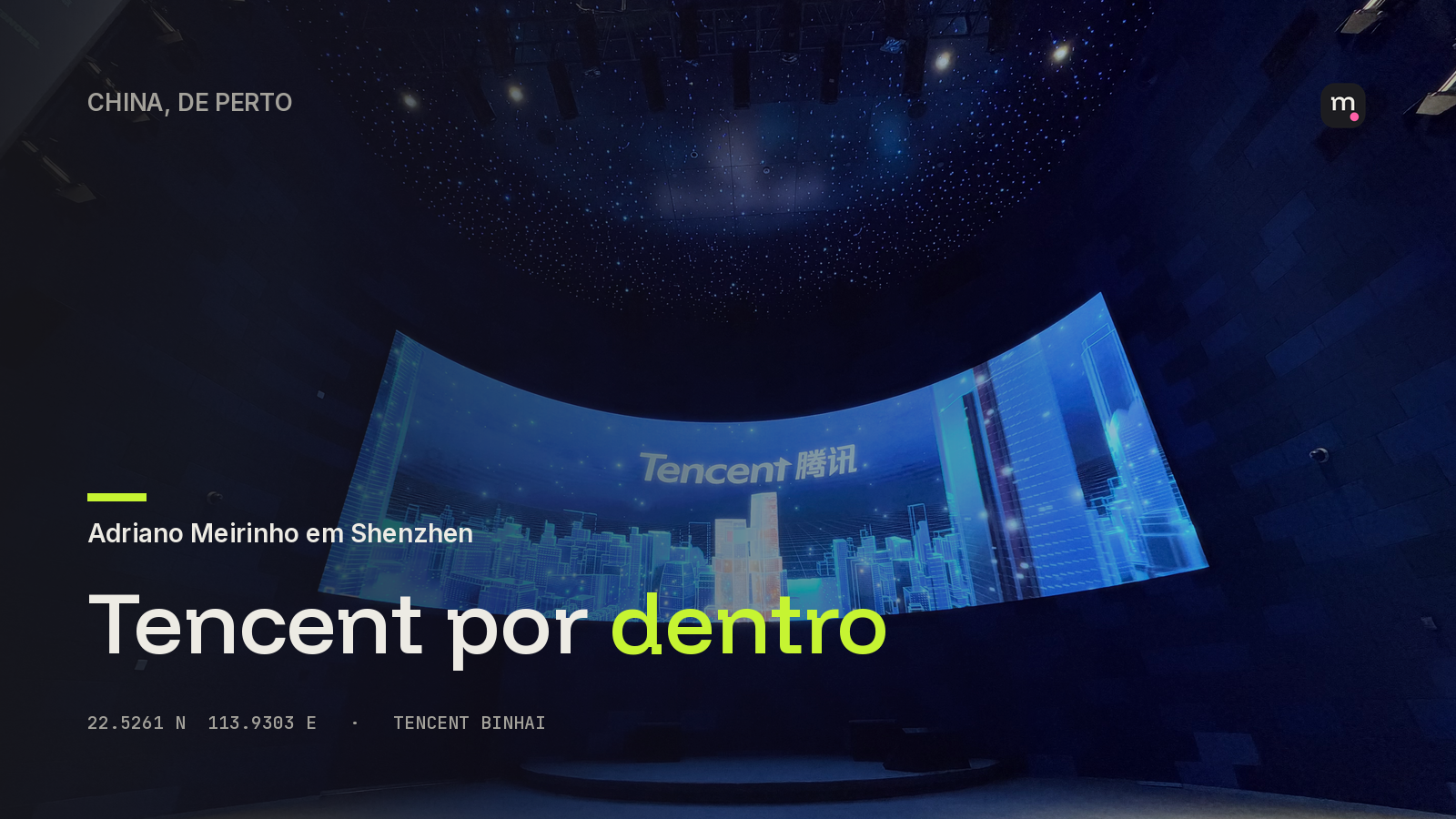
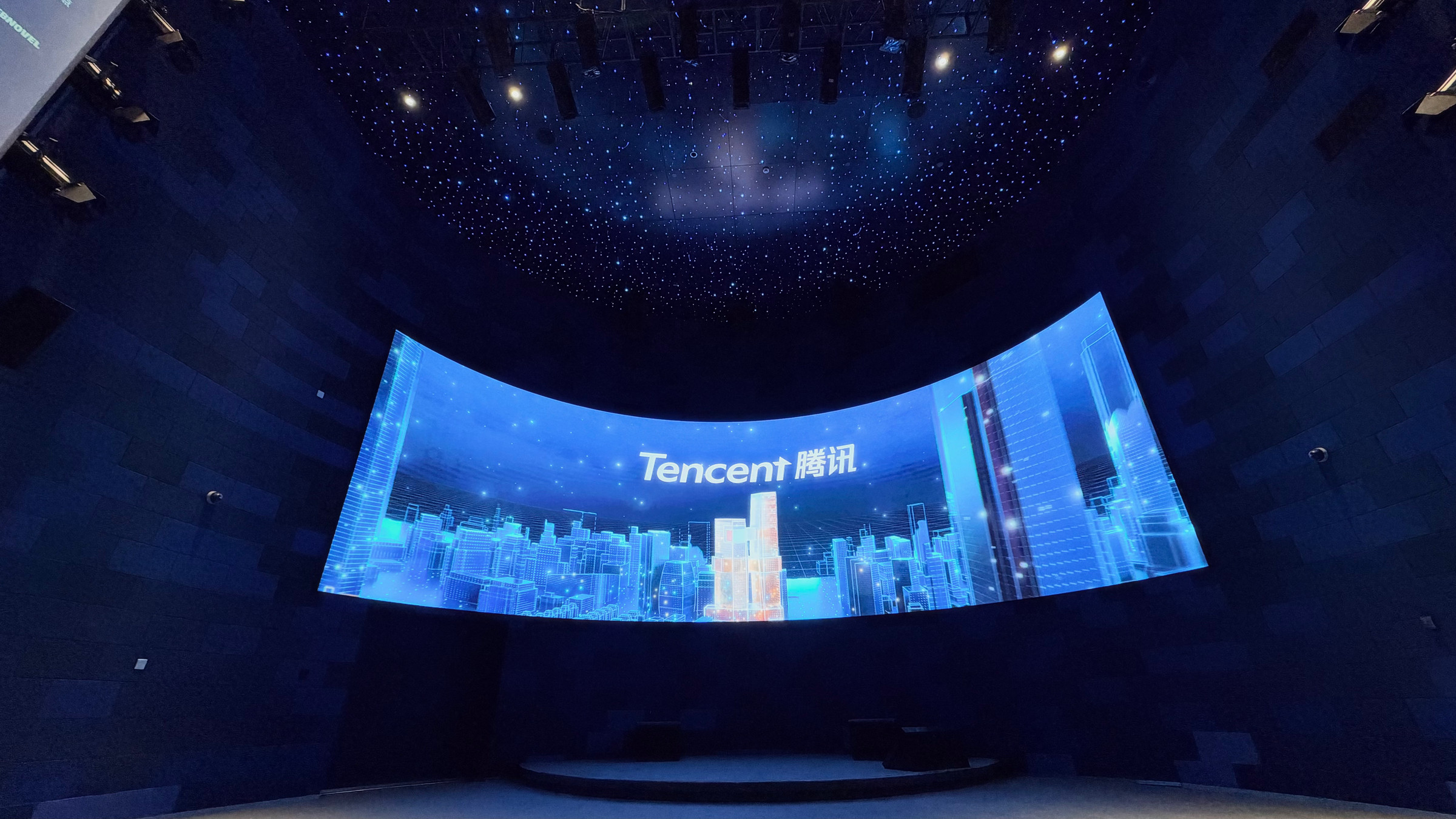
The immersive room is dark, with a starry ceiling, a circular stage and a curved screen. On it, the Tencent 腾讯 logo sits over a blue skyline. That is the image that best holds this visit. On the same screen a showreel ran, with family scenes, a boxing match and a line of intellectual property. At another moment, the screen became a grid of logos from the group itself. Among those I could read were QQ, WeChat, WeChat Pay, Yuanbao, JOOX, WeTV, WeChat Pay HK and TenPay. I am not dumping the full list; the grid was larger than what the photo holds in focus.
The cloud, on the map of the world, I have already described: more than 3,200 nodes, 24 regions, 69 zones. Beside it, another curved screen announced Weixin Cross-Border Pay, “Supporting 36 Currencies in 78 Countries and Regions”, with the line “expanding our digital infrastructure around the world”.
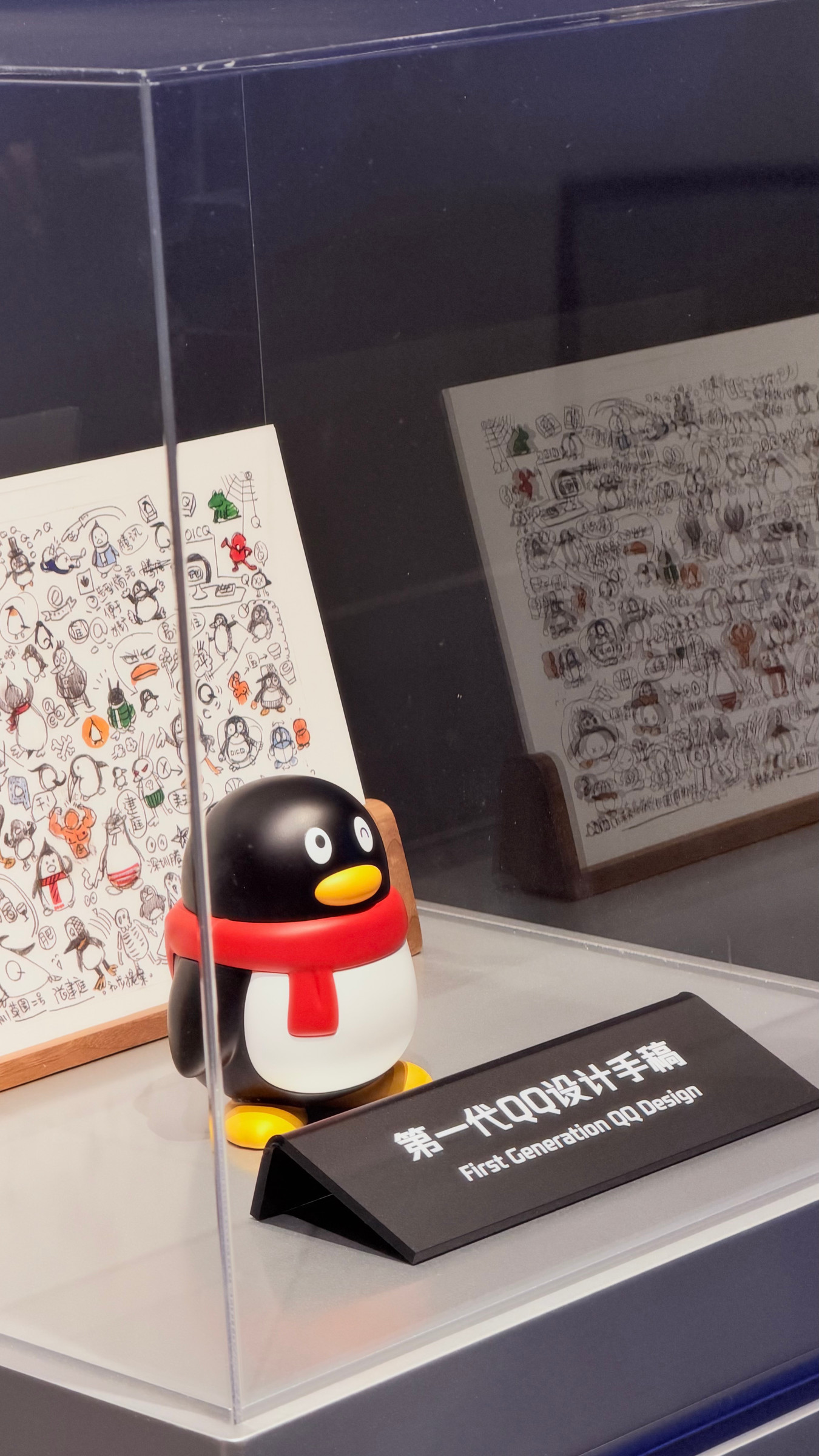
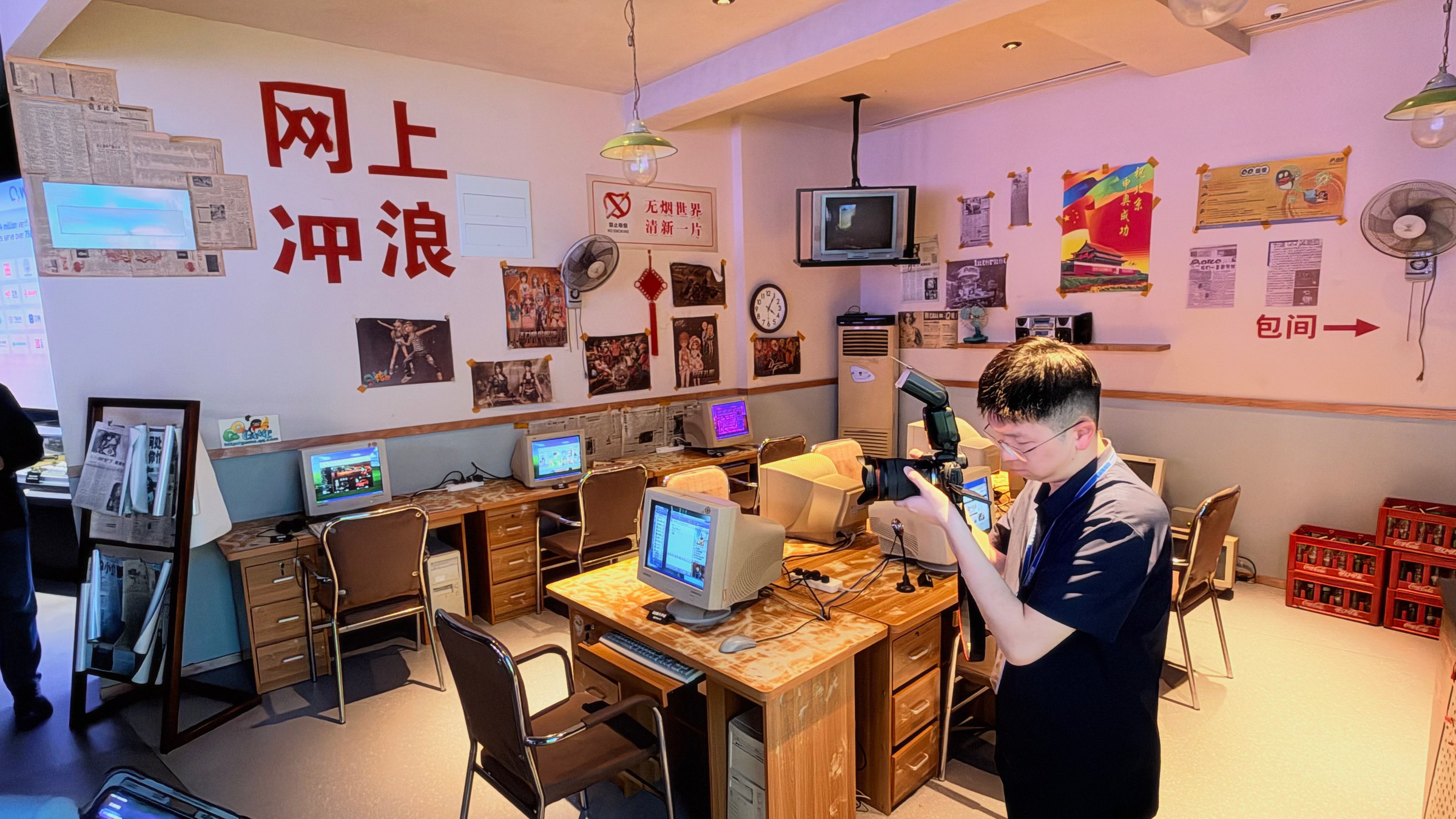
The QQ corner is the most affecting part of the hall. In a display case, the first generation penguin, with a red scarf, and the sketches behind it, with a First Generation QQ Design plaque. Beside it, a black pager with a green screen and a plaque saying that the first QQ notification sound was very similar to that of pagers. There was a red telephone on a shelf, cathode ray tube monitors, an old notebook computer and a row of old mobile phones on acrylic stands. The scenery continues in a reconstructed internet café, with a red 网上冲浪 sign, wooden desks, CRT monitors, posters and newspaper clippings on the walls.
WeChat and Mini Programs occupy the centre of this wing, on the screens I have already cited.
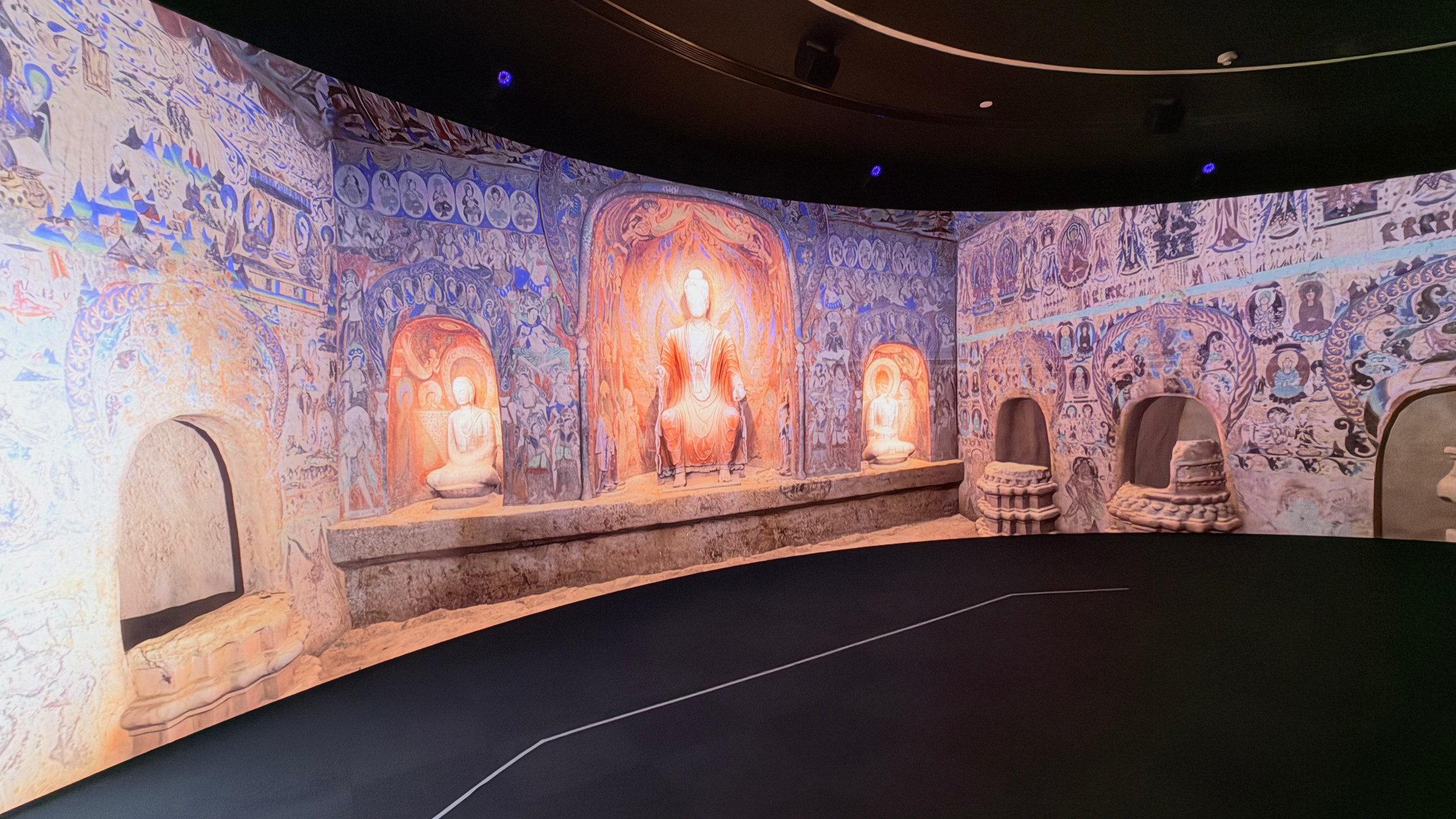
Then came a curved projection room with cave murals: niches, figures and pigment, in a setting that feels like a grotto. I walked through that projection.
The simulator sits further on, with a cockpit, a lit instrument panel and the city seen from above on the screen. The group clustered around it. I sat in the seat, in profile, with the stick in my hand.

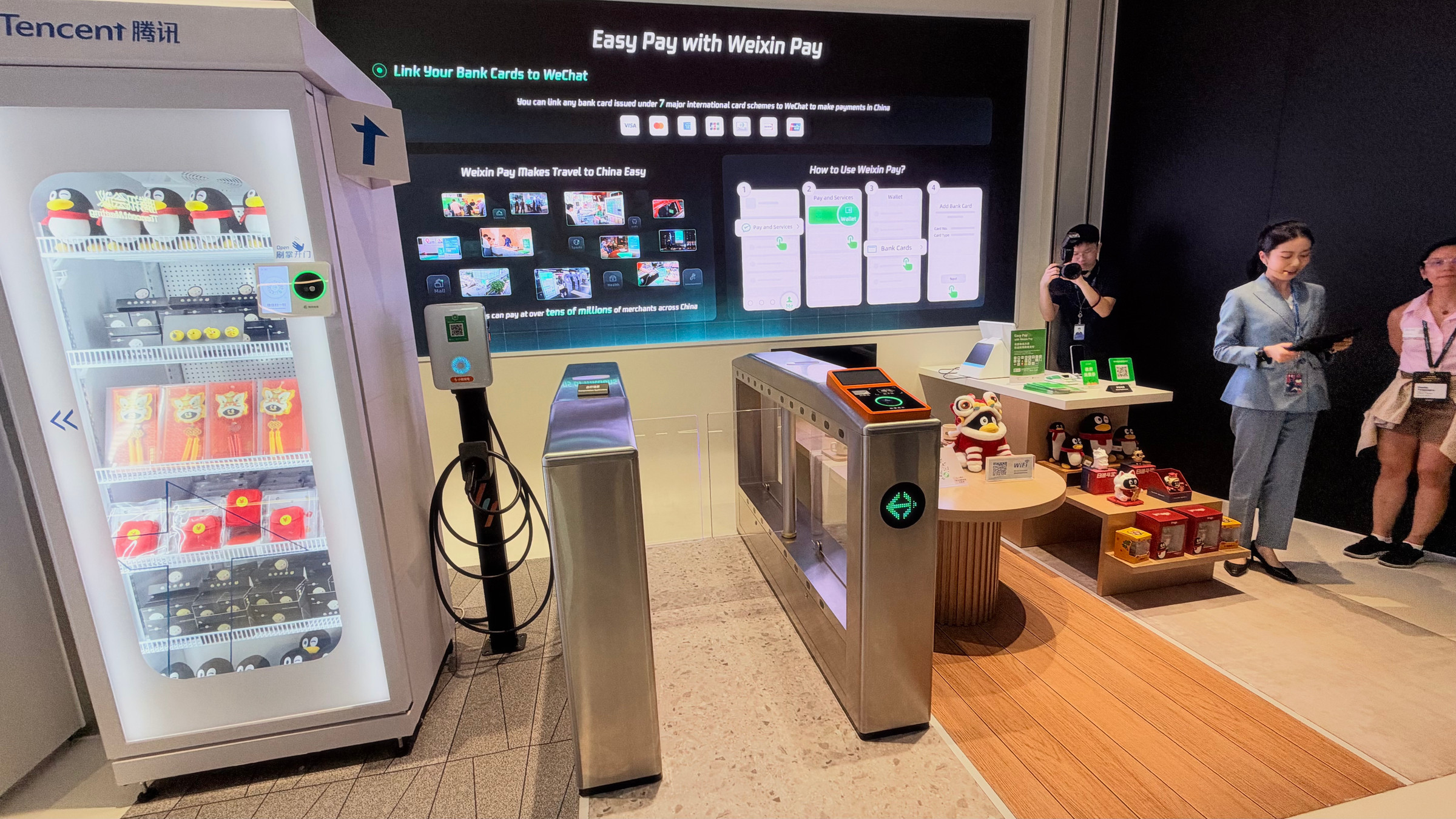
The next booth announced Easy Pay with Weixin Pay. There was a refrigerator with the Tencent 腾讯 logo and QQ plush toys, turnstiles in front, a charger to the side, and a screen inviting you to “Link Your Bank Cards to WeChat”. The same wall talked about making Weixin Pay easier to use for people travelling to China.
Further on, a Tencent Cloud screen brought together financial products. Among the names I could read were WeChat Pay, WeBank, Tenpay Global, QQ Wallet, WeSure, FusionBank, LiCaiTong and Tencent Portfolio. I do not treat that screen as a complete catalogue, or as a recommendation; it is what the hall was showing.
A brand wall came next, under a line about helping brands grow. Among the logos I could read were UNIQLO, KFC, FILA, Walmart and LI-NING, plus many others I do not need to list one by one.
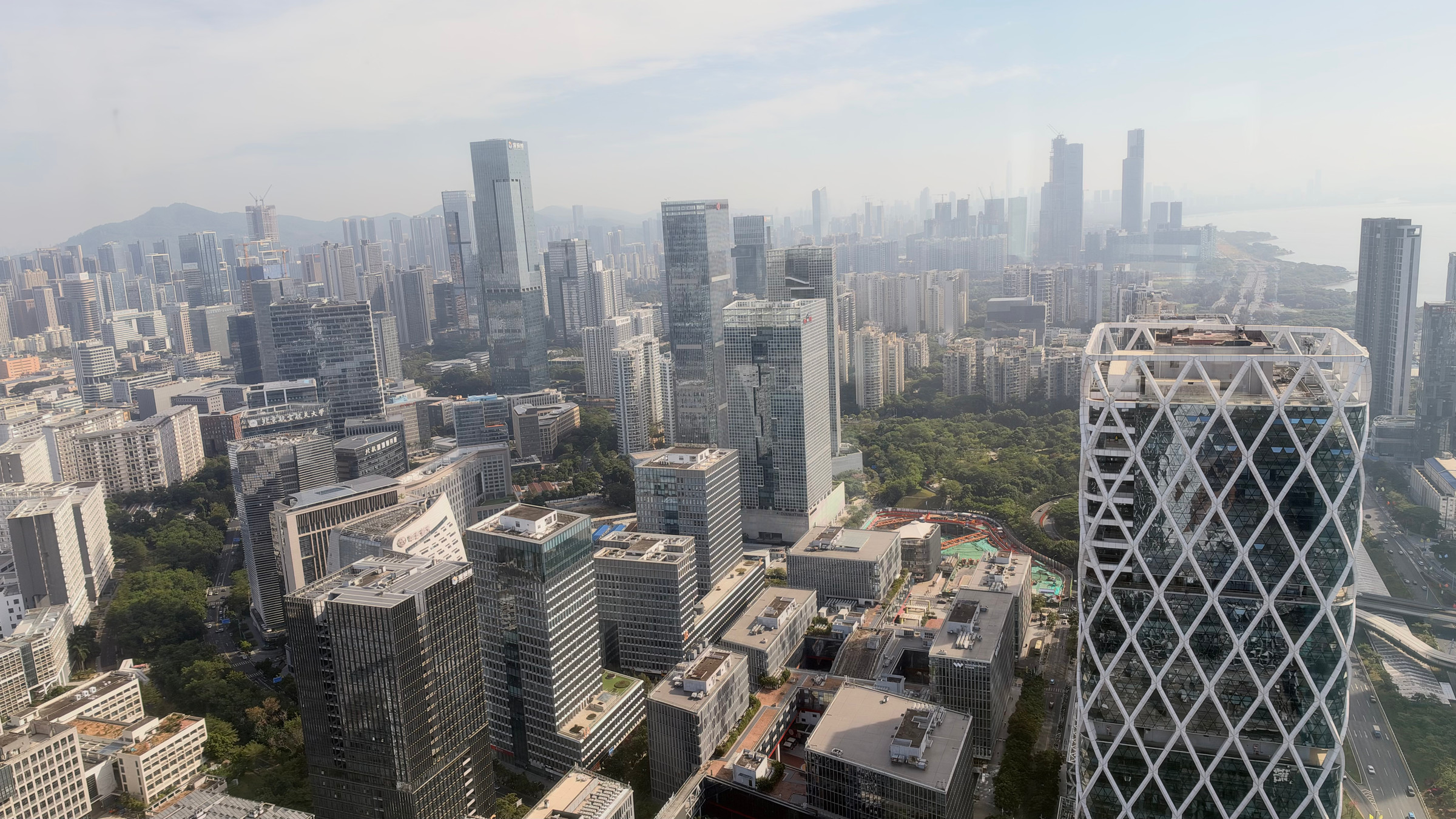
From the top of the building, Shenzhen opens up: a lattice tower in the foreground, other towers, greenery and a clear sky.
The session and the way out
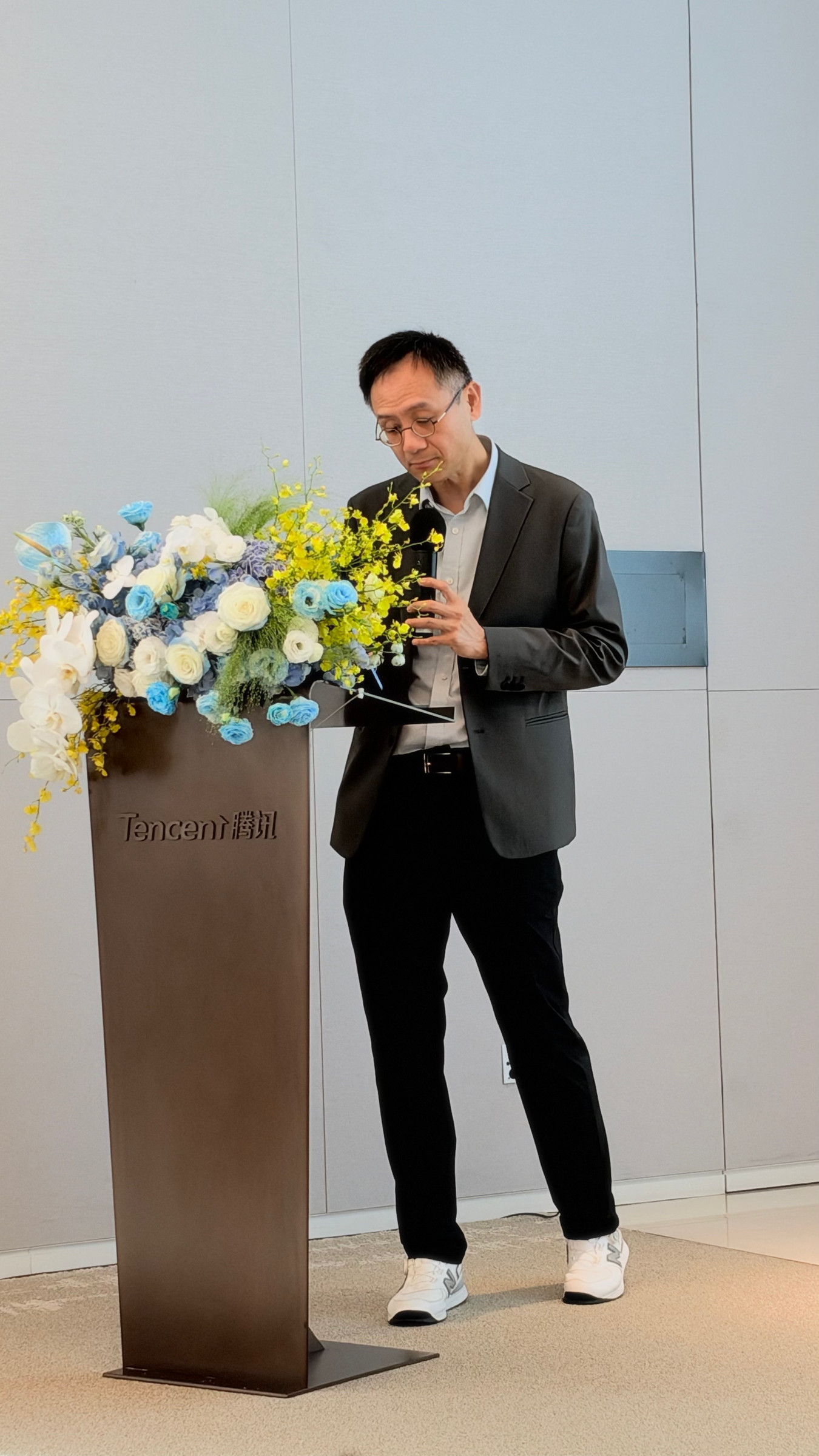
After the hall, there was a session in a Tencent room. The speaker was talking beside a lectern with the Tencent 腾讯 logo. In the frame I have, the name does not appear. I do not identify the speaker from other material of the visit.
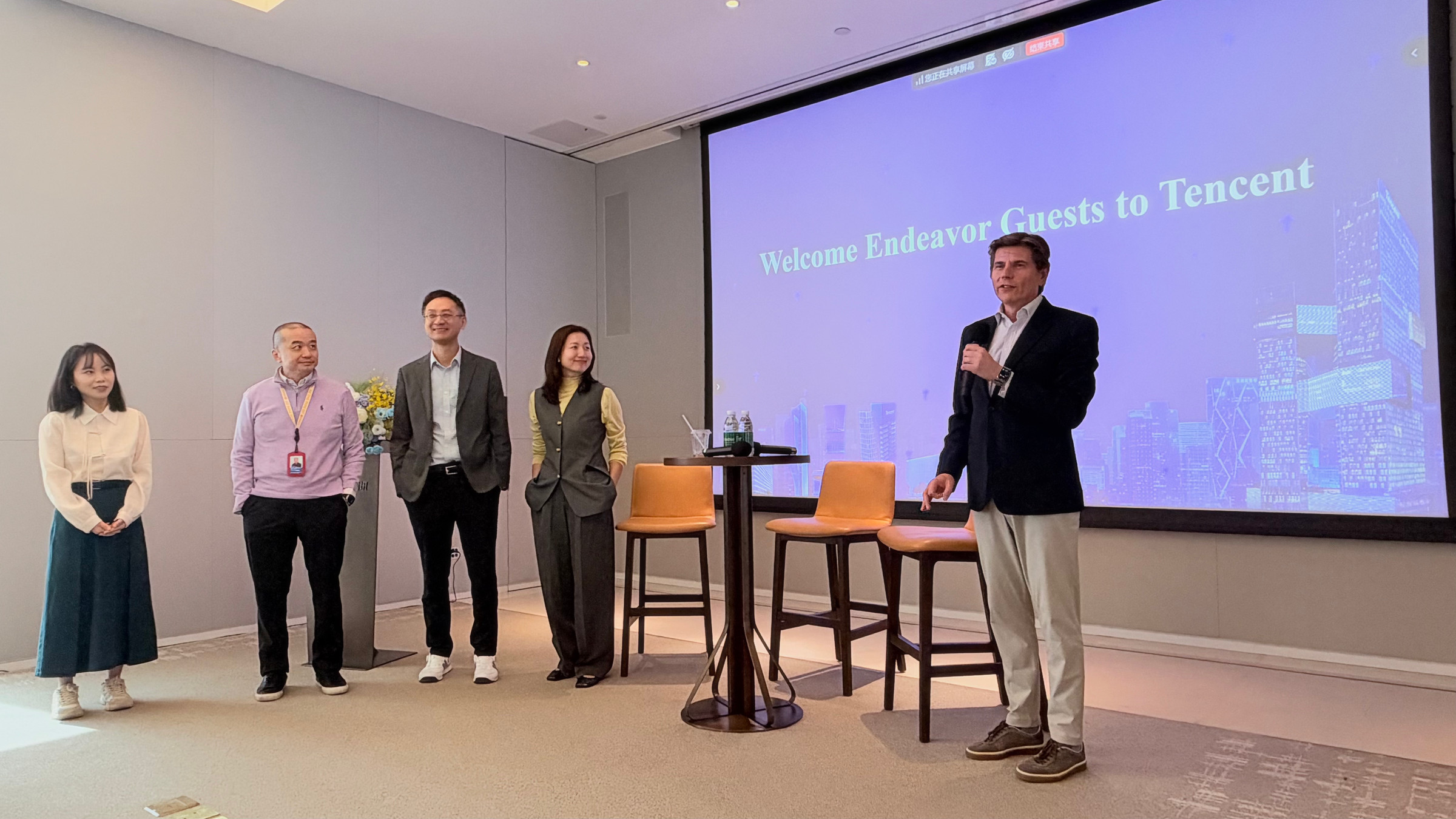
At the close, the group stood in front of the screen “Welcome Endeavor Guests to Tencent”. This visit took place on the Endeavor China Innovation Tour, the same route that had already taken me to the Alibaba campus in Hangzhou and to the XPeng campus in Guangzhou.
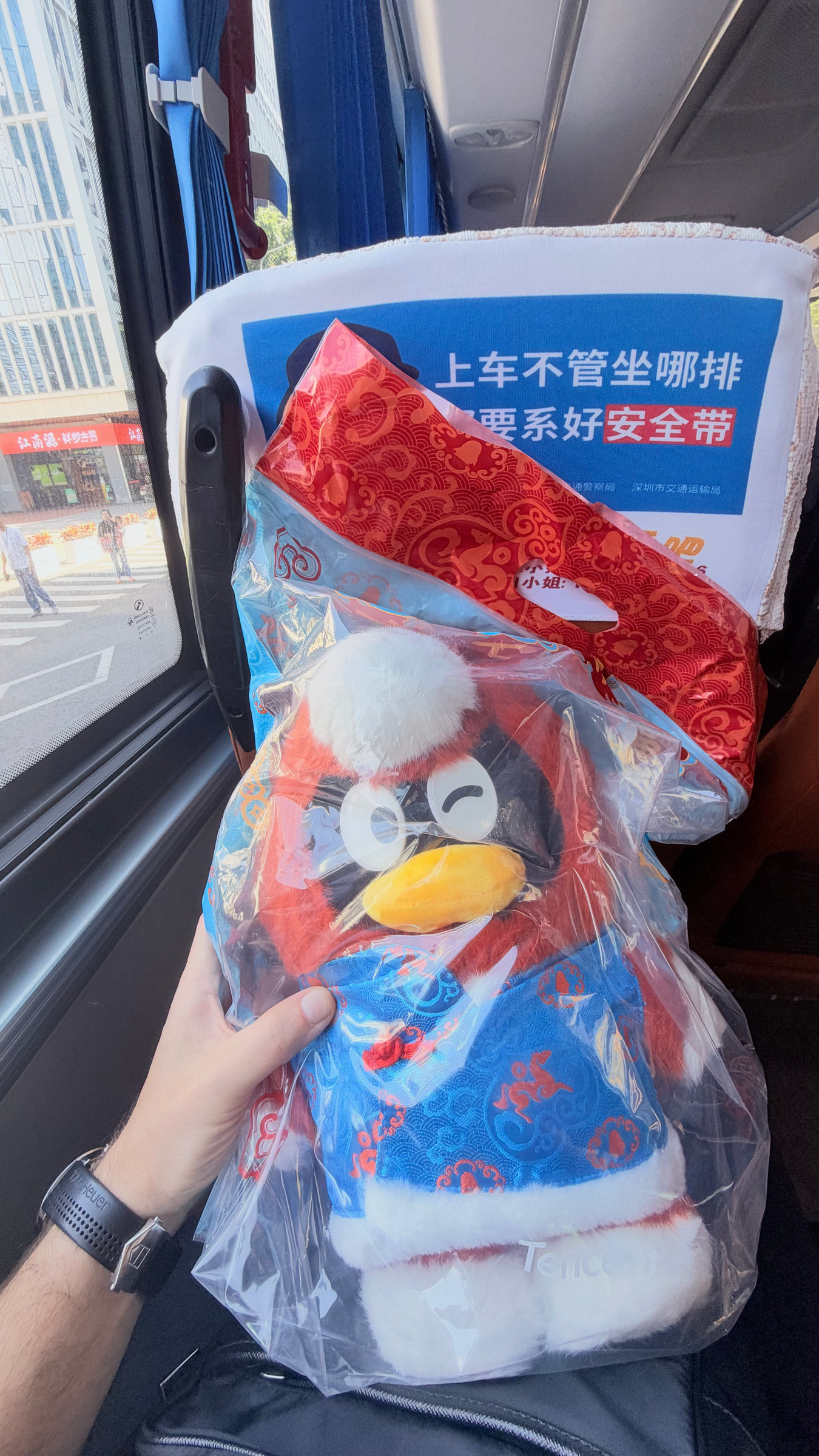
I left on the bus with a plush QQ penguin, in traditional blue and red clothing, still in its plastic, with the Tencent mark visible on the bag.
What to watch from here
Hy4. In the hall, the company presents it as the new flagship generation, with 770 billion total parameters, 49 billion active and a context window of up to 1 million. In November 2026, Tencent announced that generation on an official page. I will watch what this line becomes off the panel, including in the products the company says it already enters, and on the Hy4 and preview pages already live on this site.
WeChat. The figure of 1.4 billion or more monthly active users, with the August 2026 metric in the hall, and the 1.439 billion of the second quarter in the official results, is the scale around which the rest is organised. Mini Programs, payments and the AI tools the company places on that base are what I want to see develop.
The cloud and the bill. More than 3,200 nodes, 24 regions and 69 zones are the hall panel’s figures. On the same screen, the company wrote that it is accelerating its pace. In the second quarter results, the RMB 52.8 billion of capital expenditure, the negative free cash flow and the explanation of prepayments for compute are the other face of that. The contrast with 2025, when capital expenditure for the whole year was RMB 79.2 billion and free cash flow was still growing, is what makes 2026 a different year. That tension, between the cash the operation still generates and the investment the infrastructure is asking for, is what I will watch in the coming results. I will also watch the cut of operating profit with and without the new AI products.
WorkBuddy and CodeBuddy. The second quarter announcement places them among the new AI products. In the hall, WorkBuddy is on a totem, a dashboard and a wall of agents. I want to see whether this line, which the company describes as a productivity tool, carries the same weight outside the demonstration.
Summary table
| Topic | Main fact | Source |
|---|---|---|
| Place | Tencent Binhai, in Nanshan, Shenzhen, with the Endeavor China Innovation Tour | The visit; the “Welcome Endeavor Guests to Tencent” screen |
| The group in 2025 | Revenue of RMB 751.8 billion, up 14%; capital expenditure of RMB 79.2 billion, up 3%; free cash flow of RMB 182.6 billion | Official 2025 annual results announcement |
| The group in 2Q 2026 | Revenue of RMB 204.8 billion, up 11%; VAS, marketing and FinTech with business services as the main lines | Official second quarter 2026 results announcement |
| 1.439 billion combined monthly active accounts of Weixin and WeChat at the end of the second quarter of 2026; in the hall, 1.4 billion or more, metric as of August 2026 | Official announcement; hall panel | |
| Mini Programs | More than 100 countries and regions and more than 5 billion uses a year, according to the panel title; another panel showed Mini Programs in action at APEC, with a “Welcome to Shenzhen” | Hall panels |
| 520 million mobile monthly active accounts at the end of the second quarter of 2026; in the hall, the first generation penguin and sketches, a pager, a reconstructed internet café | Official announcement; hall case and scenery | |
| Cloud | More than 3,200 acceleration nodes spanning five continents, 24 geographic regions and 69 availability zones | Hall panel |
| AI infrastructure | Tencent In-House AI Infrastructure wall, with the Galaxy 128-GPU Supernode and Scale-Up Switch Node, GPU Node, CPU Node and Power Shelf racks | Hall panels |
| Hy4 | 770 billion total parameters, 49 billion active, a context window of up to 1 million; the company presents it as a New Flagship Generation | Hall panel; the same three figures appear in the official preview announcement of August 2026 |
| The bill | Capital expenditure of RMB 52.8 billion, up 176%; negative free cash flow of RMB 13.8 billion, with prepayments for compute | Official second quarter 2026 results announcement |
| What I saw | Patents tree, campus model, Hy4, WorkBuddy, immersive room, WeChat, QQ, a projected cave, a simulator, a Weixin Pay booth, a brand wall, a session at the Tencent lectern with no name visible in the frame, the Endeavor group on the welcome screen, the QQ penguin on the bus out | Visit to Tencent Binhai, in Shenzhen |
Frequently asked questions
Where was the visit? At Tencent Binhai, in Nanshan, Shenzhen, with the Endeavor China Innovation Tour. The closing screen read, in so many words, “Welcome Endeavor Guests to Tencent”.
Where do the Hy4 figures in this piece come from? From the curved 腾讯混元 / Tencent Hy panel in the hall: 770 billion total parameters, 49 billion active, and support for a context window of up to 1 million. Those are the figures the company was showing there. The same three figures appear in the official Hy4 preview announcement of August 2026. When I cite the announcement, I also use the word “tokens”, which is there and is not on the panel.
Of when is the 1.4 billion WeChat figure? The hall panel shows “1.4 billion+” monthly active users, with the label “As of August 2026”. That August is the date of the metric, not the day of the visit. The official second quarter 2026 results show 1.439 billion combined monthly active accounts of Weixin and WeChat at the end of that quarter. They are metrics from different months, both from the company.
And the cloud figures? From the Tencent Cloud Infrastructure panel in the hall: more than 3,200 acceleration nodes spanning five continents, 24 geographic regions and 69 availability zones worldwide. When I talk about what I saw at Binhai, I use those figures.
Who was the speaker? In the frame I photographed, the name does not appear on the lectern or behind it. I do not identify the speaker from that photo.
Is this piece a note on the Hy4 launch? No. This piece is the visit to Tencent Binhai, with the company’s public context. The Hy4 figures that enter here when I talk about the hall are those of the panel. The official Hy4 announcement and the preview announcement enter as public sources of context, not as a substitute for the visit.
I left Binhai on the bus, with the penguin still in its plastic. What remained was the scale of the operation seen from the inside: Hy4 on the panel, WeChat at the centre of the room, the cloud on the map, and an Endeavor delegation welcomed in writing on the screen. That is the visit I am taking with me.