

I left Shanghai on a high speed train at 9:15 and, an hour later, I was in Hangzhou, the city where Alibaba was born. In the afternoon, with the Endeavor China Innovation Tour delegation, I spent four hours at the Alibaba Cloud campus, among data center models, a spiral sculpture bearing the Qwen name and a hanging sign that read QwenCloud. Photos help tell the story, but in infrastructure what sits in the showroom is usually the smallest part of it.
This piece is an attempt to gather the rest. It brings together what Alibaba itself has published, what serious reporting in China, the United States, Europe and Brazil found over the course of 2026, and what I saw on campus. Where sources disagree, I keep both versions. Where sources do not settle a question, I leave the question open.
I start with a number anyone can check. In the latest quarter already published, revenue from Alibaba's AI Cloud and Compute Services segment was RMB 48.437 billion (US$7.139 billion), up 45% year on year, according to the official results. In the same quarter, group capital expenditure was RMB 67.678 billion, 75% above the prior year, according to the results PDF. Those two numbers sum up the Alibaba of 2026 better than any slogan: the cloud is growing fast, and investment is growing faster.
I have been on the internet since 1995 and I have built financial infrastructure in Brazil for many years. Almost three decades of internet taught me to distrust every technology stack until I understand who pays the bill for each layer. That is the lens I took to Hangzhou, and it is the lens I used to organize what follows.
From Hangzhou in 1999 to "the Google of China"
Alibaba Group was established in 1999 by 18 people led by Jack Ma, then an English teacher in Hangzhou. The group's corporate page, describes the founding idea as the internet in service of small businesses that wanted to compete at home and abroad. The same page now presents the group as a global technology company focused on AI + Cloud and commerce, with the Qwen model family at the base of its services for businesses and consumers.
Between those two portraits lie more than 25 years of e-commerce, payments, logistics and cloud. What changed in 2026 was the order of the words. A company that for years was described by its commerce came to be described by its computing. The line that best captures the shift came from consultant Duncan Clark, of BDA, speaking to the Financial Times: Alibaba is trying to reposition itself as "the Google of China", anchored in cloud, its own models and its own chips.
The shift has a symbolic moment. Lin Junyang, Qwen's technical lead, wrote on X that he was stepping down. The same day, Yu Bowen, head of post training, left. Hui Binyuan, from Qwen Code, had already gone to Meta. The most detailed reconstruction of the episode is in the Geopolitechs newsletter, which translated reporting by LatePost and 36Kr. According to that account, the Tongyi Lab, under Alibaba Cloud CTO Zhou Jingren, planned to reorganize Qwen's vertical team into horizontal teams by function, the opposite of what Lin argued for. At the emergency meeting that afternoon, still according to the account, CEO Eddie Wu spoke directly to the team and Zhou heard an uncomfortable question: why startup customers could buy compute on Alibaba Cloud with ease while the internal team lived on a tight GPU quota.
Caixin published a profile of Lin with a detail that Western media barely used: Qwen's open source strategy was set by Zhou Jingren. Lin, for his part, put the chance of China producing a world leading AI company within three to five years at about 20%.
A month later, the FT, in a piece by Eleanor Olcott and Zijing Wu, closed the arc. Zhou took control of the AI division, the company began to prioritize models it can monetize, and a source summed up the internal criticism bluntly: the previous team was "too focused on benchmark rankings and open source, which does not create value for the cloud business". The same piece revealed that the HappyHorse video model, released without attribution, was Alibaba's.
Reuters had already reported the formal reorganization, with the creation of the Alibaba Token Hub, a business group run by Eddie Wu himself, and a new enterprise agent platform inside DingTalk, which according to the agency has more than 20 million corporate users. Caixin reported the consolidation of the company's AI office tools under QwenWork, alongside the launch of Qwen3.8-Max. The Inference reports that Dayiheng Liu has led the Qwen project.
There is also a governance detail I record with care. The corporate page lists Joe Tsai as Director and Chief Executive Officer, while the results already published still name Eddie Wu as CEO. I did not find a dated announcement of the change, so I do not treat it as settled fact.
The map almost nobody draws
Anyone trying to explain Alibaba to an outsider runs into overlapping names: Alibaba Group, Alibaba Cloud, Tongyi Lab, Qwen, Qwen Cloud, Model Studio, Bailian, Wan, QwenWork, Qoder. A survey done for this research with the X API counted, in a seven-day window, about 14,400 original posts on X about Qwen 3.8 and Qwen 4 and only 45 with the name Qwen Cloud. In Portuguese, almost nobody draws this map. It is worth trying.
The group and its four segments. Starting with the latest quarter already published, Alibaba began reporting four segments, according to the official results PDF. The first is Alibaba E-commerce Group, which brings together China commerce, international commerce, Freshippo and parts of Cainiao, with revenue of RMB 205.862 billion in the quarter. The second is AI Cloud and Compute Services, which combines Cloud Intelligence Group and T-Head, the chip unit, with RMB 48.437 billion. The third is AI Labs and Applications, with the model labs, Qwen's consumer business and QwenWork, at RMB 3.338 billion and negative Adjusted EBITA of RMB 13.861 billion. The fourth, All Others, houses Alibaba Health, Amap, entertainment, games and other businesses, with RMB 28.803 billion. Consolidated revenue was RMB 268.953 billion, up 9%.
That split already says a lot. Cloud and chips now sit on the same reporting line. Models and consumer apps got their own segment, still small in revenue and very expensive in results. Commerce remains the largest business and the one that funds much of the rest.
Qwen, the model family. Qwen is the name of Alibaba's language and multimodal models, developed at Tongyi Lab and, for many versions, published with open weights on Hugging Face and ModelScope. It is also the name of the consumer app and also of the QwenWork workplace agent. The brand became an umbrella.
Wan, the video family. Wan is the video generation line. Version 3.0 entered public beta, according to the Model Studio blog and the Alibaba Cloud Community. Alongside it, the corporate page lists HappyHorse, a video model with a cinematic bent, and HappyOyster, a real time world model product, both already introduced.
Model Studio and Bailian, the model serving platform. At the Alibaba Cloud Summit in Hangzhou, the company described Bailian as its model serving platform, "also known as Model Studio outside China" (announcement). The official FAQ says Model Studio offers several model families, including the Qwen series. That is where the documentation, per token prices, regions and API keys live.
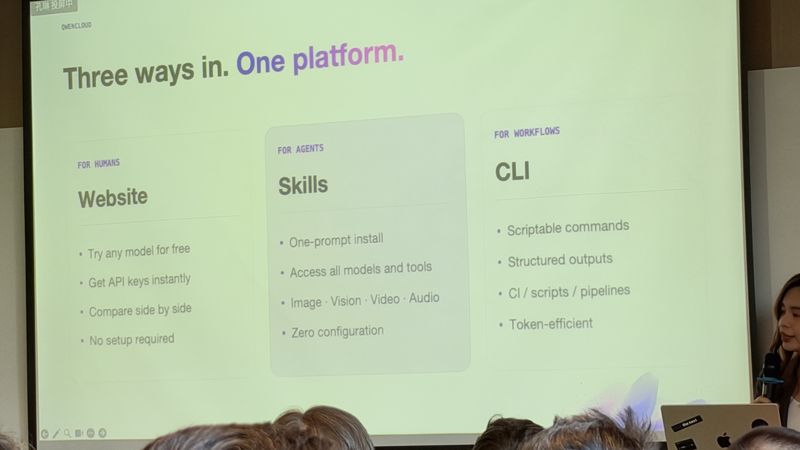
Qwen Cloud, the AI native cloud. In Singapore, Alibaba Cloud introduced Qwen Cloud as "a new AI-native cloud platform designed to provide a seamless model service experience for both businesses and AI agents" (announcement). The design has three entry points: a website for people, Skills for agents and a CLI for automated workflows. The catalog mixes Qwen models, open models and third party offerings. The public site qwencloud.com loads normally, and the prices it highlights, checked during the visit, match the international Model Studio table for Singapore.
The question I leave open. What exactly is the relationship between Qwen Cloud and Model Studio? The official sources I found treat Qwen Cloud as an AI native cloud platform and Model Studio as a model development and serving platform. In the Wan 3.0 announcement, the two appear side by side as separate doors for requesting beta access. Third party integrator documentation talks about unifying the DashScope, Bailian and Model Studio brands under the QwenCloud name outside mainland China. I found no official statement saying so, nor one saying one product replaced the other. Until there is a primary source, I treat both as entry points into the same Alibaba Cloud, with a relationship still undefined in public.
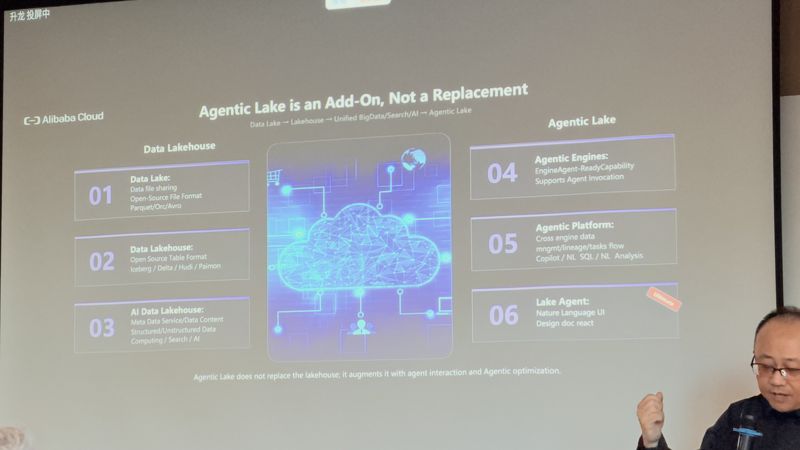
OpenLake and Agentic Lake. There is a second open question of the same kind. The official OpenLake documentation, describes a lakehouse for big data, search and AI, built on Data Lake Formation, with open formats such as Paimon, Iceberg and Lance and paths to RAG and agents. In the presentation seen in Hangzhou, the name that appeared was Agentic Lake, in a session called "Alibaba Agentic Cloud & Agentic Lake", with a slide titled "Agentic Lake is an Add-On, Not a Replacement", which places agents on top of the lakehouse (IMG_1622 and IMG_1632). Going by the title, Agentic Lake adds a layer to what already exists. Even so, I found no public source matching the two names, and I do not assume they are the same product.
Qoder and Qwen Coder. A third point of confusion showed up in my own photos. The coding model line is called Qwen-Coder, a name adopted with the launch of Qwen2.5-Coder. The AI coding panel I photographed in the showroom carries another brand, Qoder, an Alibaba Cloud workspace and coding agent product already relaunched, according to the Alibaba Cloud Community. They are different things, and the label on the glass said Qoder.
With these pieces, the map looks like this: a group with four segments; inside the cloud, T-Head chips, classic infrastructure, Model Studio and Qwen Cloud; inside labs and applications, the Qwen and Wan models, the Qwen app and QwenWork; and, cutting across everything, the Qwen brand, which today names a model, an app, an agent and a cloud at the same time.
Chips, power and concrete
The Alibaba of 2026 is first of all a work of physical engineering. In 2025, the group announced a plan to invest at least RMB 380 billion, about US$53 billion, over three years in cloud and AI infrastructure, an amount the announcement itself describes as more than the company's combined spending on cloud and AI over the previous decade. On the latest published quarter earnings call, the company said it had already invested more than RMB 190 billion of that plan.
The company attributed the RMB 67.678 billion of capex in a single quarter to purchasing cycles, more CPU capacity ahead of expected agent adoption and pricier components. The long term target came at the Apsara Conference: more than 20 GW of global data center capacity by 2032, according to the corporate page. Exame, in a piece by Tamires Vitorio, carried a Citigroup estimate few repeated in Portuguese: those 20 GW could generate more than US$160 billion in external cloud revenue.
In the Apsara keynote, whose full text Alibaba Cloud published, Eddie Wu used a metaphor that helps explain the strategy. Chips are power plants, and the cloud is the grid. He spoke of recursive self improvement in Qwen and of a model with 5 to 10 trillion parameters, and admitted that medium term demand far exceeds supply. Reuters reported the giant model plan the same day, and the shares rose about 5%.
T-Head and Zhenwu. The chip unit took center stage. At the Summit, T-Head presented the Zhenwu M890 processor, with three times the performance of the Zhenwu 810E, 144 GB of memory, 800 GB/s of chip to chip interconnect and native precision from FP32 to FP4. Alongside came the ICN Switch 1.0, at up to 25.6 Tbps, the T-Head SAIL software stack and the Panjiu AL128 server, with 128 accelerators in a single rack. On that date, the company said it had delivered more than 560,000 Zhenwu chips, with more than 400 external customers in 20 industries (announcement). In the results already published, adoption through Alibaba Cloud appears as more than 650 external customers, including in autonomous driving, internet and financial services. At Apsara came the Zhenwu V900, described as three times the performance of the M890, with mass production and sales planned for the first quarter of 2027.
Exame reported, based on an SEC filing, more than 100,000 Zhenwu units running in the public cloud and more than 30 automakers and autonomous driving companies among users. Reuters, citing IFR in a piece republished by The Standard, reported that T-Head plans a Hong Kong IPO in 2027 raising US$2 billion to US$3 billion. The source is anonymous, and the company has not confirmed the plan.
The H200s stuck in Hong Kong. The in house chip takes on another meaning when you look at the GPU market. Reuters, in a piece republished by CNA, revealed that about 600,000 Nvidia H200 chips were stockpiled in Hong Kong awaiting Beijing's approval. Several large Chinese internet companies received about 10,000 each in recent months, and an eight H200 server was offered for more than 6 million yuan, about triple the price a year earlier. The story notes that, according to The Information, Beijing wants companies to prioritize Chinese chips for inference, and that ByteDance, Alibaba and Tencent ordered more than 3 million RTX Pro 5500 cards, a version allowed under US export rules. The bottleneck, then, sits on both sides of the Pacific.
Asia Times, citing IDC data via Reuters, put Nvidia at 34% of data center accelerator shipments in China in the first half, against 28% for Huawei, with Nvidia's shipments down 44% in a year (Asia Times).
The cloud got more expensive. One data point runs against the price war narrative. Alibaba Cloud announced increases of 5% to 34% on AI compute products and 30% on CPFS storage, according to the official notice. At the compute layer, the company is charging more. At the model layer, the movement is more mixed, as I show below.
For someone like me, who pays for infrastructure in Brazil, this is the most concrete part of the story. Models draw the attention. The real constraint remains physical: chips, power and the buildings that must exist before an agent answers any request. I wrote about this on the site when the generator queue became a strategic asset, and Alibaba is one more example of the same phenomenon.
The Qwen family and the rest of the catalog
The 3.8 generation. Alibaba Cloud announced Qwen3.8-27B, a dense, natively multimodal model with a 262,000 token window extendable to 1 million. In the same text, it released the weights of the flagship Qwen3.8-2.4T-A95B, with 2.4 trillion total parameters and 95 billion active, described as the first open release of a Qwen-Max class model. The official QwenLM/Qwen3.8 repository records the flagship weights and the 27B weights, and the corporate page lists the official launch of Qwen3.8-Max. I cite the records as the sources list them, without forcing a single debut.
Qwen3.8-Flash came next, with a 262,144 token context expandable to 1 million. Valor, republishing Reuters, reported a price of 1 yuan per million input tokens and 3 yuan for output, and a training cost about one ninth of Qwen3.7-Plus. The company also opened the weights of Qwen3.8-Flash-Next, presented as a preview of the Qwen 4 architecture. The Brazil region announcement describes the open Qwen3.8-Flash as a mixture of experts model with 125 billion total parameters and 6 billion active per token.
Prices you can check. On the international Model Studio table for Singapore, Qwen3.8-Max costs US$2 per million input tokens and US$6 for output, and Qwen3.8-Flash, US$0.15 and US$0.47 (pricing table). As a list price reference, with no claim to compare quality, the OpenAI table checked the same day showed GPT-5 at US$1.25 and US$10, and Anthropic's showed Claude Sonnet 5 at US$2 and US$10. Models of different generations and purposes are not equivalent, and list price says little about the cost per task solved.
The metrics war. No serious observer disputes that Qwen is the most adopted open model family in the world. What the coverage shows, read together, is that each source measures something different. Alibaba speaks of more than 3 billion downloads and more than 300,000 derivative models, and says it has opened more than 460 models. Bloomberg, in a piece published by Folha, spoke of more than 3 billion in the last six months, citing a Hugging Face report, against 418 million for Google and 227 million for Meta in 2026. The ATOM Report by Nathan Lambert and Florian Brand counted about 942 million cumulative downloads and 69% of new derivatives built on Qwen. Foreign Policy counted 151,448 derivatives on Hugging Face, 4.7 times Llama. Cohere speaks of more than 113,000 derivatives. Caixin spoke of more than 1 billion downloads and 200,000 derivatives.
These numbers coexist. They measure different periods, repositories and criteria, and anyone who uses them as if they were the same indicator ends up comparing apples and oranges. In the showroom there was a panel with Qwen adoption figures. I do not reproduce them here, because the panel's layout can blur downloads and derivatives.
Qwen-Coder and Qoder. The coding line exists and remains documented. The Alibaba Cloud Community introduced Qwen3-Coder-Next, an open model for coding agents, and the QwenLM/Qwen3-Coder repository also lists Qwen3-Coder-480B-A35B-Instruct. The Qwen-Coder documentation itself, recommends evaluating the latest general purpose model for many coding tasks. It is a sign that the line between specialized and general models is getting thin. The Qoder product occupies the layer above, the tool layer.
Wan 3.0. For video, the official announcement speaks of native generation of up to 30 seconds, multimodal input with text, image, audio, video, pages and documents, and reference consistency. The Alibaba Cloud Community described pricing from US$0.05 per second at 480p. Reuters tied the general availability launch to the US$10 billion share sale. On X, according to the survey done for this research, the Wan conversation belongs to creators and video platforms, with about 1,250 posts in seven days.
Apple's endorsement. The quarter's most symbolically weighty news came from Cupertino. SCMP reported that Apple Intelligence arrives in China, with iOS 27.3, after a developer beta, with Qwen integrated. According to The Inference, Apple also evaluated other Chinese companies before choosing. With the news, Alibaba's stock closed up 8.45% in Hong Kong.
Open where it builds reach, paid where it competes with the cloud
To understand Qwen's commercial turn, you need to put three documents together. The first is the FT piece, on the priority given to models the company can monetize. The second is the ChinaTalk analysis by Jordan Schneider and Nick Corvino, published under the title "China's AI Companies Are Going Closed Source". It notes that Qwen3.6-Plus and Qwen3.5-Omni came out only as hosted services and argues that Chinese funding, orders of magnitude smaller than American funding, cannot sustain open source at the frontier. Nathan Lambert replied in the comments that he saw it as the first sign of a slow transition to a hybrid model.
The third document is the license. SCMP reported that Qwen3.8-Max came with open weights and a separate commercial license for anyone running model as a service or a workplace assistant with revenue above US$50 million over 12 months. Internal use is exempt. On X in Portuguese, according to the same X API survey, this clause barely circulated.
Read together, the three texts support a coherent thesis. Qwen stays open where openness builds reach, ecosystem and derivatives, and starts charging where openness would compete with Alibaba's own cloud. Foreign Policy used an analogy that helps: the relationship between Linux and Red Hat. The code circulates, and whoever wants to operate at scale pays for the version with support, service and guarantees.
At the same time, the public message became more open than ever. At the opening of the World Internet Conference in Wuzhen, chairman Joe Tsai said open source is the "only" path to a sustainable AI industry, according to SCMP. The coexistence of the two messages, the license and the stage, is the most interesting editorial knot at the company today. I read both as the same strategy seen from two sides.
The question for Qwen 4 is straightforward. Third party accounts attribute to Dayiheng Liu a commitment to keep public weights for Qwen 4 and Qwen 5, but I did not find that commitment in a primary source. Nor do I know whether the US$50 million clause becomes standard. For a Brazilian company considering an open Alibaba model in production, the license of the specific repository matters more than the headline. The Qwen3.8 repository itself shows different licenses depending on the model, between Apache 2.0 and the Qwen Community License.
There is also a new regulatory element. Beijing proposed export controls on 23 AI technologies, including models, agents and compute clusters. The Ministry of Commerce said most remain free, with a simplified license for open source, and MiniMax has already registered, according to Reuters. I found no news on Alibaba's registration.
The rival that matters most is in Beijing
Western media tends to compare Qwen with American models. The contest that shapes Alibaba's pricing, products and strategy, according to the Chinese press, is with ByteDance, owner of Volcano Engine, the Doubao assistant, Feishu and the Seedance video model.
Both companies declared themselves number one in the same IDC report on the first half model as a service market. The AsiaICT analysis, signed by Dingshan, untangled the apparent contradiction. Volcano holds 45.1% of total MaaS, and Alibaba holds 46.6% of the language model segment. Almost 90% of Volcano's MaaS revenue comes from video and other modalities, and almost 90% of Alibaba's comes from text. The whole market billed RMB 10.63 billion in the half, up 889.4%, and the average price per million tokens rose from about 2 to about 3.7 yuan, driven by video, which is expensive.
The same text records, citing the earnings call, Alibaba's target for model and application services: from RMB 10 billion annualized in the latest quarter already published to RMB 30 billion by year end, with the figure already above RMB 16 billion. I could not check the exact wording in the official transcript, so I attribute it to AsiaICT. It is the most useful yardstick for the next quarterly results.
On the consumer side, the yardstick is Doubao. According to QuestMobile data, reported by Kuai Keji, Doubao had 419 million monthly active users against 158 million for the Qwen app. Qwen grew the most in the year, 5,076%, but the absolute gap remains about 2.65 times. Alibaba reports more than 300 million monthly active Qwen users across all platforms, and the results PDF says 250 million users had their first AI shopping experience through the app's agentic features. These are different cuts from QuestMobile's and should not be mixed.
At work, the contest is between DingTalk, Feishu and Tencent's WeCom, and it helps explain the consolidation of Alibaba's workplace agents into QwenWork. In video, Wan and Seedance compete for the same revenue from creators and businesses.
There is an irony worth recording, because it shows that the Chinese ecosystem is more intertwined than the word "race" suggests. According to MiniMax's HKEX announcement, MiniMax, which also develops models, raised its annual caps on purchases of cloud services tied to Alibaba Cloud to US$300 million in 2026, US$400 million in 2027 and US$500 million in 2028, a sum of US$1.2 billion. A lab that competes with Qwen is also a customer of the cloud that hosts Qwen.
The bill: capex, cash and the next-results yardstick
Financial coverage of Alibaba in 2026 is harsher than the press releases. CNBC, in a piece by April Roach, highlighted the 75% drop in net income for the latest quarter already published and quoted Citi analysts worried about capex 75% higher and negative free cash flow of RMB 44.7 billion.
The results themselves show where the growth is and where the cost is. Revenue from AI related products within the cloud was RMB 12.376 billion, the twelfth consecutive quarter of triple digit year on year growth. The same document cites the Omdia report "AI Cloud Market: China, 2025", according to which Alibaba Cloud ranked first in China's AI cloud market with a 38.1% share. Exame reported an annualized run rate of RMB 49.5 billion for AI products. The FT, for its part, says most AI revenue in the cloud still comes from GPU rental.
Inside commerce, the picture is one of shifting mix. China commerce fell 8%, to RMB 110.9 billion. Quick commerce, which includes Taobao Instant Commerce, Freshippo and Tmall Supermarket delivery, grew 45%, to RMB 53.295 billion. International commerce was roughly flat, with AliExpress posting an operating profit in the quarter, and global wholesale grew 7%. The analysis translated by China on China calculated that Alibaba spent RMB 95.45 billion more on sales and marketing since launching Taobao Flash Purchase, without ever disclosing the standalone results of that operation. Part of the cash that could go to data centers is going to the delivery war.
Three days after the results, the company launched a HK$80 billion placement, about US$10.2 billion, described by Reuters as the largest follow on primary offering in the history of the Hong Kong exchange. It sold 710 million shares at HK$112.70, an 8.4% discount, and the stock fell 8% at the next open. The official completion announcement, says where the money goes: about 60% to global compute infrastructure and about 40% to hyperscale data centers and the "Agentic Cloud".
The Inference, in a piece by Vincent Jiang, framed the question that matters for the next results. Based on SEC filings, it showed that capex in one quarter went from US$4.39 billion in 2024 to US$18.21 billion in 2026, while operating cash flow for the same period fell from US$3.23 billion to US$1.37 billion. The metric that will drive the reading of the results is cloud revenue growth against capex. The benchmark scoreboard takes a back seat.
Before the results, the market had already cast a vote of confidence with the Apple news, and another price signal appeared around then. According to The Standard, Alibaba Cloud raised the Token Plan quota on the personal edition and cut the list price of the Pro package. I have not yet found the official announcement, and the move contrasts with the compute price increase of up to 34%. At the model layer for end users, prices seem to be falling, while at the compute layer they went up.
São Paulo on Alibaba's map
Alibaba Cloud opened its first cloud region in South America, in São Paulo, with two data centers, according to the official announcement. With it, the company reached 106 zones in 31 regions. The region offers compute, storage, networking, security, databases and cloud native services. On AI, the text uses a careful verb: the company "plans to introduce" a suite of agent services in the region.
Valor added that the data centers sit in Ascenty, Equinix and Cirion facilities, and that the local partners are Insi, focused on large and mid sized companies, and 4Linux. The latter presents itself as Alibaba Cloud's official open source AI partner in Brazil, focused on deployment, RAG and training on Qwen. With the Amsterdam region, the network reached 109 zones in 32 regions. In Latin America, Alibaba already had a region in Mexico, opened in 2025, with a second zone opened in 2026.
There is a practical distinction few have made. The Model Studio regions documentation, lists only Beijing, Singapore, Virginia, Frankfurt, Tokyo and Hong Kong. Brazil is not on the list. A Brazilian company can host data and applications in São Paulo, and the model still runs outside the country. For anyone handling sensitive data, that changes the architecture and the contract, because the prompt leaves Brazil for the model's region.
Signing up also has its details. For anyone in Brazil, access is through the international site, and the default contracting entity is Alibaba Cloud (Singapore) Private Limited, according to the payment methods page. Model Studio prices are in US dollars, and the free quota for several models exists only in the Singapore region, for 90 days.
Huawei Cloud, which also competes in China's cloud market, has operated in Brazil longer and at greater scale: three local zones and more than 100 companies using its model service, according to the company itself. Alibaba arrives later, with Qwen as its calling card.
The richest Brazilian case, however, came before the region. IplanRio, the IT company of Rio de Janeiro's city government, published Rio 3.5 Open, with 397 billion parameters, presented as Brazilian and sovereign engineering. O Globo, in a piece by Bruno Romani, and Estadão, in a piece by Roberta Jansen, showed that the model was a weight merge, 60% Nex-N2-Pro, from a Shanghai lab, and 40% Qwen3.5-397B. The documentation credited only Qwen. IplanRio apologized, blamed an operational failure in the release and promised a new upload, which, by the time of Estadão's story six weeks later, had not happened.
Rest of World, in a piece by Kinling Lo, noted that Brazil split about US$444 million in supercomputing between Chinese suppliers and a tender expected to go to American chips, and recorded the government's line about not depending on a single company, technology or country. It is the portrait of a country buying from both sides.
The word sovereignty comes up often in this debate. When the model's base is Chinese, the license is open and the data center may be in another country, it takes on layers that call for more precision than a launch speech usually offers. It is a topic I intend to explore in another piece.
What I saw in Hangzhou
We reached Hangzhou by high speed train, a one hour ride from Shanghai, and went on to the Alibaba Cloud Campus, in Sandun, in the Xihu district. The visit ran from 13:30 to 17:30.
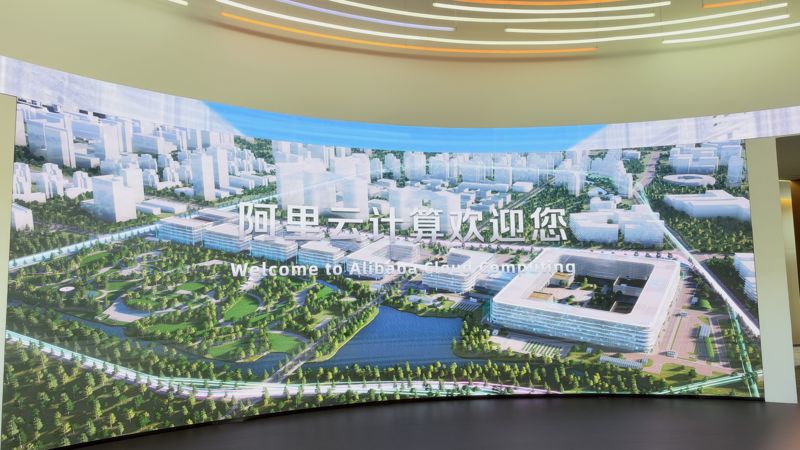
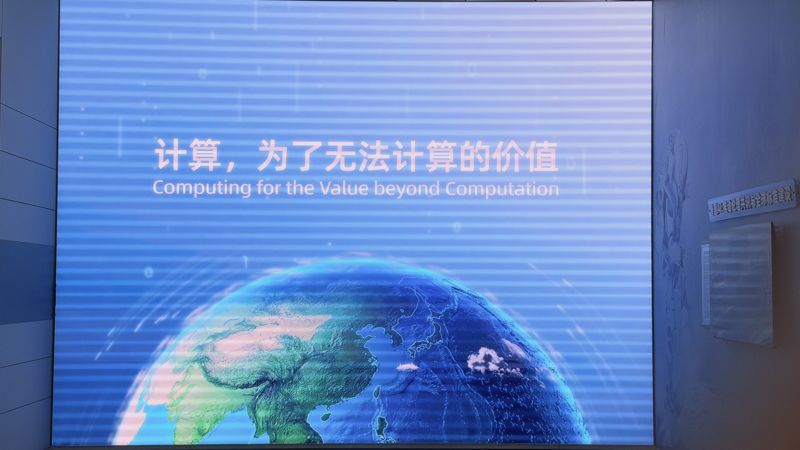
The welcome was a curved screen with the words "Welcome to Alibaba Cloud Computing" and a digital model of the campus (IMG_1517). Further in, another screen carried the motto "计算,为了无法计算的价值", translated as "Computing for the Value beyond Computation" (IMG_1585).
The company's origins showed up in the visit. The feeling was one of modernism, performance, confidence.
In the showroom, the centerpiece was a spiral sculpture bearing the Qwen name, above a screen reading "For Agentic Era Full-Stack Ready" (IMG_1523 and IMG_1527). Nearby, a hanging ring shaped sign carried the QwenCloud brand, and it is the photo where I am pointing at the name (IMG_1541). There was also a multimodal models panel with Wan, HappyHorse and Happy Oyster (IMG_1534), the Qoder branded AI coding panel (IMG_1535) and a display of Qwen Glasses (IMG_1536).

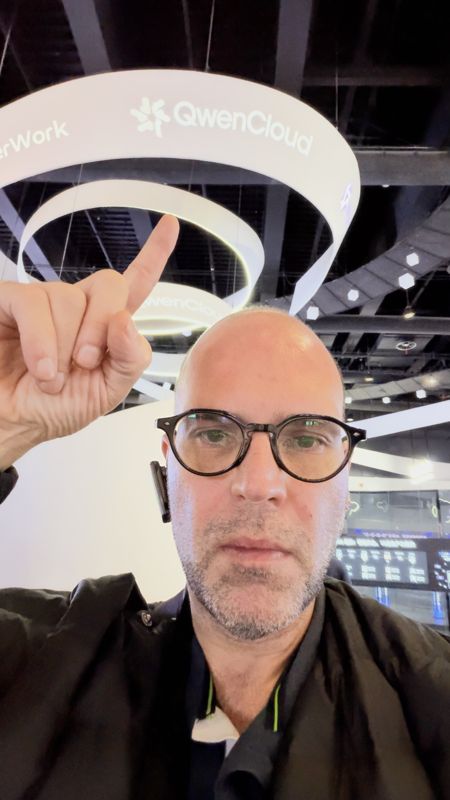
What caught my attention were the applied use cases, and seeing where they are running their models, major global brands with the model.
The infrastructure section was physical and didactic: a lit scale model of a data center with racks and colored pipes under glass, with the Alibaba Cloud panel (IMG_1545), an open AI server rack in a display case (IMG_1531), a screen showing a floating data center with the words "China Hangzhou" (IMG_1547) and a model of an energy park with solar panels and wind turbines (IMG_1576). One panel covered agent infrastructure under the title "Six Challenges, Six Capabilities", citing governance, security and memory (IMG_1540). Another spoke of an "AI-Native Organization" (IMG_1552). There was also an automotive AI showroom, with a concept car and screens (IMG_1560).
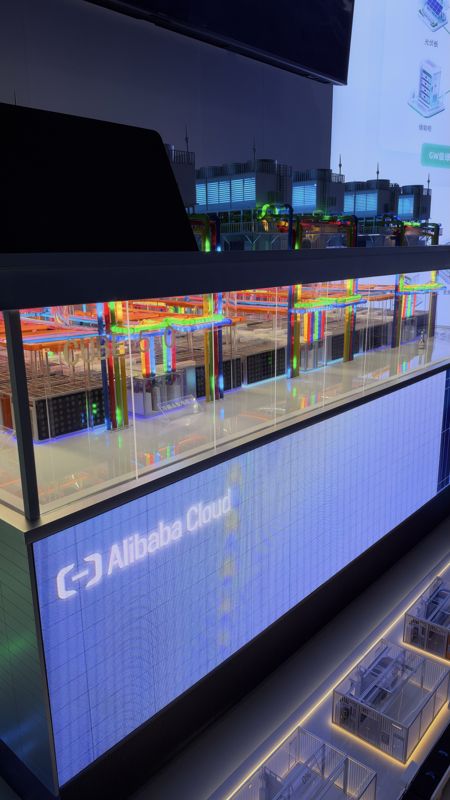
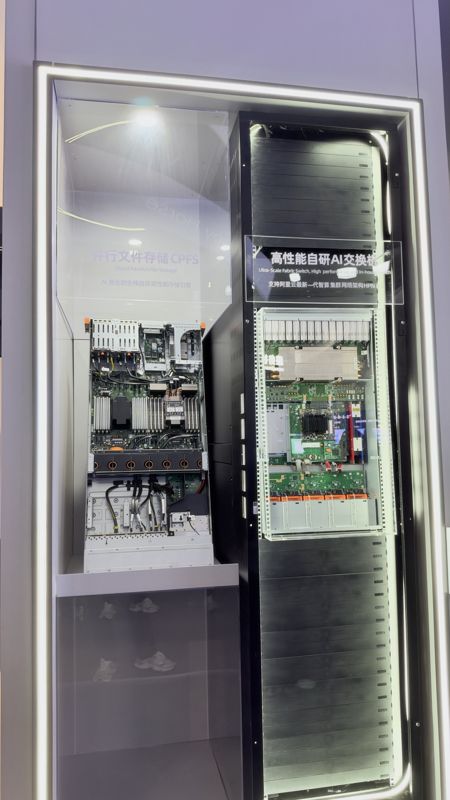
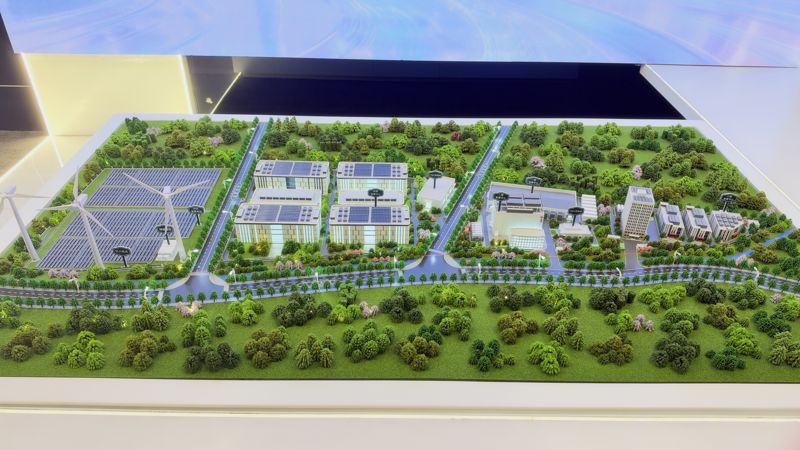
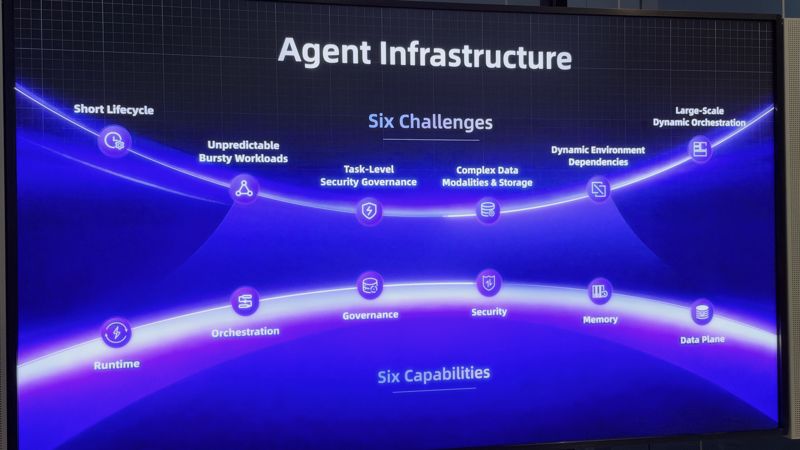
What became clearer was the capacity for scale, and the solidity.
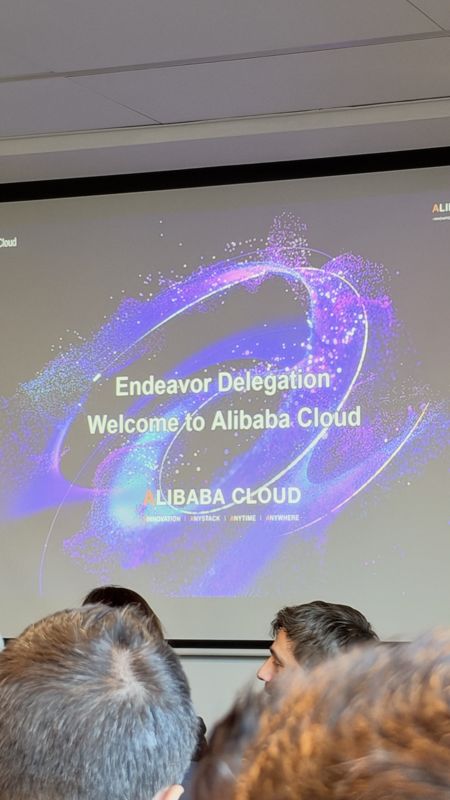
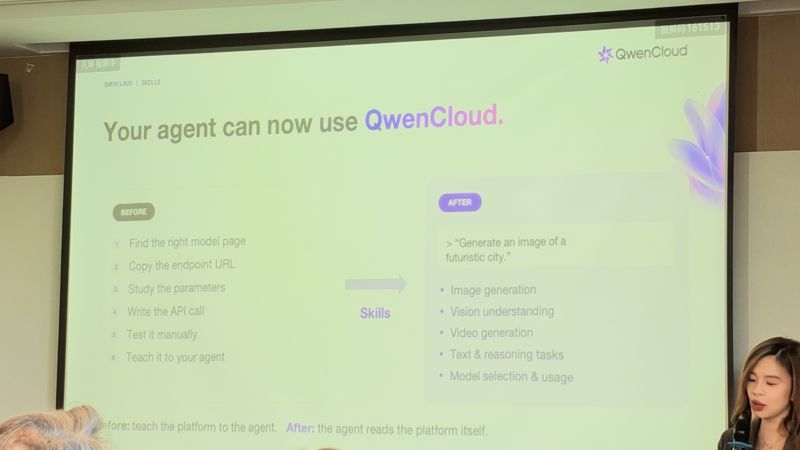
After the showroom came the talk in the auditorium, opened by a screen welcoming the Endeavor delegation (IMG_1593). The first session presented QwenCloud under the title "Building cloud platforms for humans and AI agents" (IMG_1594). One slide summed up the design as "Three ways in. One platform.", with website, Skills and CLI (IMG_1600), the same as the official sources. Another, "Your agent can now use QwenCloud", showed an agent before and after Skills (IMG_1603). Another slide carried the title "Machine thinking: Over 1,000x of All Humanity Combined" (IMG_1595), a claim from the presentation that I record as such.
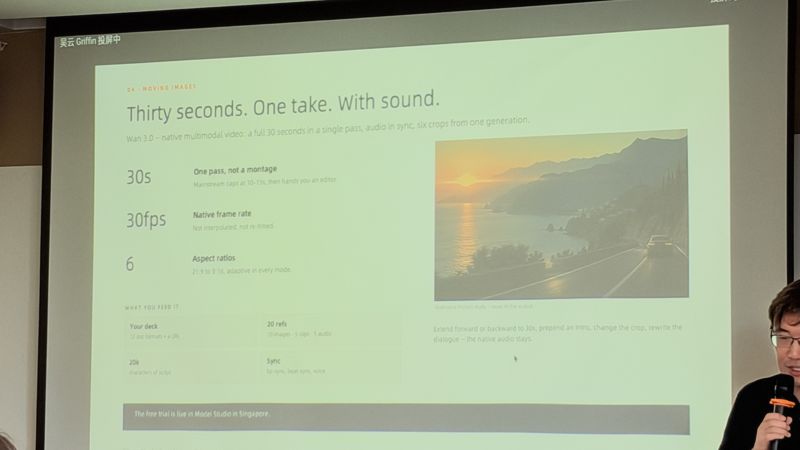
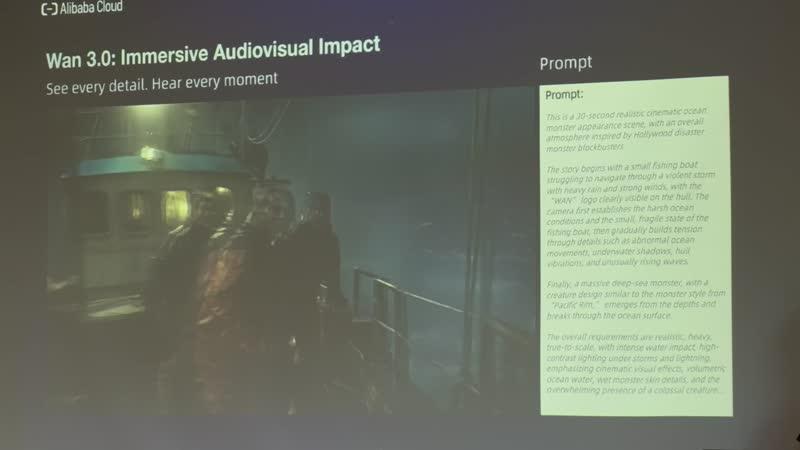
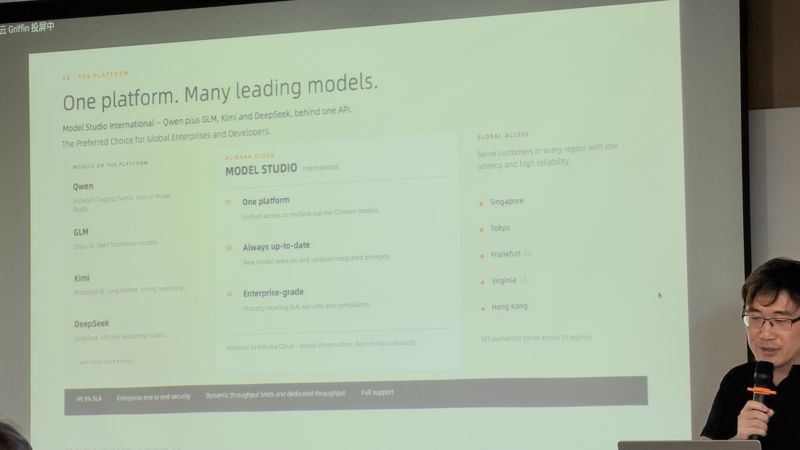
In the "Qwen & Wan" session (IMG_1604), they showed Qwen Image 2.0 with multilingual content (IMG_1605) and a Wan 3.0 sequence: "Thirty seconds. One take. With sound." (IMG_1608), "Omni-Reference", with video generated from reference images (IMG_1609 and IMG_1610), "Hyper-Realistic World Renderer", with an underwater scene (IMG_1612), and "Immersive Audiovisual Impact", with a ship in a storm and the prompt alongside (IMG_1614). Then came Model Studio, presented as "One platform. Many leading models." (IMG_1616 and IMG_1617). Note that, on the same afternoon, QwenCloud and Model Studio each had their own slides, each with its own single platform promise.
The "Alibaba Agentic Cloud & Agentic Lake" session (IMG_1622) showed the data and AI stack, with model, agents and data lake (IMG_1625), the agentic cloud product line split into agent, platform and infrastructure (IMG_1629) and the Agentic Lake slide as a complement to the lakehouse (IMG_1632). There was also a case presented as "Alibaba Cloud Powers LEGO's Full-Stack Cloud and AI Journey" (IMG_1621).
The last part belonged to QwenWork (IMG_1637), with three levels of productivity (IMG_1642), multimodal generation of image, video and audio (IMG_1643), marketing content generation (IMG_1644), a Taobao connector for store operations (IMG_1645), multilingual listings (IMG_1646), an agent that fills out legal documents from a template, on the "Legal: Document Fill Out" slide (IMG_1641), a live demo of an operations dashboard (IMG_1650) and the product's SaaS and VPC editions (IMG_1651 and IMG_1652). Numbers and client logos that appeared on screen are left out of this piece.
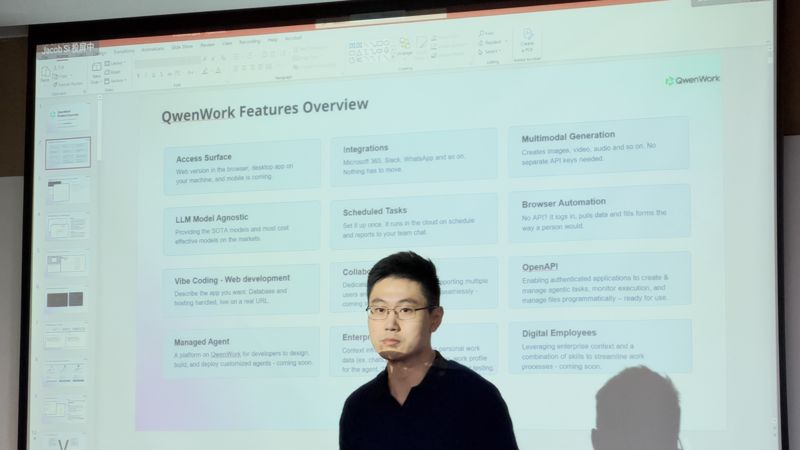
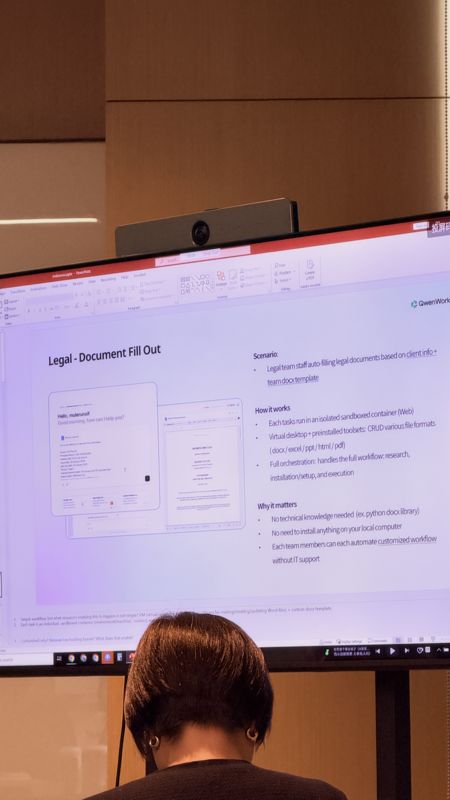
The company's public information confirms both names. QwenWork is the current workplace agent platform, launched in beta by Alibaba Group, according to the official announcement and the product documentation. The announcement says QwenWork was built on the capabilities of earlier platforms, including QoderWork. QoderWork remains documented, but Alibaba Cloud has already issued a notice that the product will stop operating, with office scenarios moving to QwenWork and programming scenarios moving to the Qoder desktop.
I followed these sessions in the auditorium with the Endeavor delegation, from the welcome to the QwenCloud and Qwen & Wan presentations, and the summary above comes from the photos I took of them.
In the session, the relationship between Qwen Cloud and Model Studio became clear.
The agent section, with governance, security and memory on the showroom panel, is the same ground we covered on cel_agents, in the episode on agents with clear limits.
What to watch from here
The next results. Alibaba will still report the following quarter, according to The Inference, which cites the 6-K filing. The points I will look at are AI Cloud and Compute Services revenue growth against capex, the progress of model and application services against the RMB 30 billion annualized year end target cited by AsiaICT, free cash flow, the AI Labs and Applications loss and any standalone figure for the delivery operation.
Qwen 4. Qwen 4 had not yet been released. The only written record from Alibaba itself that I found is the Apsara announcement, which says the model is in training. The rest is stage and code: slides with the line "Qwen4 Series Coming Soon", with Max, Plus, Flash and 27B versions, reported on X; the phrase "Qwen4 next week", attributed by an attendee to CTO Feifei Li in Amsterdam; a pull request in the Qwen Code repository, with identifiers such as qwen4-max and qwen4-coder-plus, reported by The Inference; and the "The becoming begins" teaser. Asia Times, in an essay by Noman Shah, read the teaser through Zhuangzi: the fish Kun becomes the bird Peng, and the bird needs accumulated wind to fly, as the model needs data centers. When Qwen 4 arrives, the right questions will be the license, the size of the open weights and the regions where it will be available as a service.
The H200s and Zhenwu. If Beijing releases the chips held in Hong Kong, the split of capex between Nvidia and in house chips may change. The T-Head IPO, if confirmed, will disclose the unit's own numbers for the first time.
Apple in China. Qwen inside Chinese Apple Intelligence may narrow the gap with Doubao. It may also happen that users never know they are using Qwen.
Agentic AI in São Paulo. The promise to bring agent services to the Brazilian region still lies ahead. I will be watching for when, and whether, Model Studio shows up on the regions list with São Paulo.
Summary table
| Topic | Key fact | Date | Source |
|---|---|---|---|
| Founding | Group established in 1999 by 18 people led by Jack Ma, in Hangzhou | 1999 | Alibaba Group |
| Investment plan | At least RMB 380 billion (about US$53 billion) over three years in cloud and AI | official release | Alibaba Group |
| Cloud | AI Cloud and Compute Services at RMB 48.437 billion, up 45% | latest published quarter | Official results |
| Capex | RMB 67.678 billion in the quarter, up 75% | latest published quarter | Results PDF |
| Segments | Four: E-commerce, AI Cloud and Compute, AI Labs and Applications, All Others | latest published quarter | Results PDF |
| Qwen Cloud | AI native cloud with website, Skills and CLI; relationship with Model Studio still open | official release | Alibaba Cloud |
| Chips | Zhenwu M890 launched; V900 mass production planned for Q1 2027 | official release | Alibaba Cloud |
| Capacity | Target of more than 20 GW of data center capacity by 2032 | official release | Alibaba Group |
| Models | Open weights for Qwen3.8-2.4T-A95B and Qwen3.8-27B | official release | Alibaba Cloud |
| License | Separate commercial license above US$50 million revenue for MaaS and assistants | SCMP | SCMP |
| ByteDance | Volcano with 45.1% of total MaaS; Alibaba with 46.6% in language models | H1 2026 | AsiaICT |
| Capital | HK$80 billion placement, the largest follow on offering in Hong Kong's history | official release | Alibaba Group |
| Brazil | First region in South America, with two data centers in São Paulo; Model Studio not on the regions list | official release | Alibaba Cloud; regions |
| Next results | Following quarter not yet published | The Inference | |
| Qwen 4 | Not yet released; teaser "The becoming begins" | Asia Times |
Frequently asked questions
What is Qwen? Qwen is Alibaba's family of AI models, developed at Tongyi Lab, with many versions published with open weights on Hugging Face and ModelScope. The company opened the weights of Qwen3.8-27B and Qwen3.8-2.4T-A95B, according to Alibaba Cloud.
What is the difference between Qwen Cloud and Model Studio? Qwen Cloud was introduced as an AI native cloud, with a website, Skills for agents and a CLI (Alibaba Cloud). Model Studio, called Bailian in China, is the model development and serving platform. There was no official statement that one replaced the other.
Is Qwen still open source? In part. Qwen3.8-Max came out with open weights but with a separate commercial license for MaaS or assistant operators with revenue above US$50 million over 12 months, according to SCMP. Some versions, such as Qwen3.6-Plus, came out only as hosted services, according to ChinaTalk.
How much is Alibaba investing in AI? The plan announced in 2025 calls for at least RMB 380 billion, about US$53 billion, over three years (Alibaba Group). More than RMB 190 billion had been invested, according to the official earnings call.
Does Alibaba Cloud have a region in Brazil? Yes. Its first South American region opened in São Paulo, with two data centers (Alibaba Cloud). The Model Studio regions list did not yet include Brazil (documentation).
Who is Alibaba's main model rival in China? ByteDance, with Volcano Engine and Doubao. In the first half of 2026, Volcano led total MaaS with 45.1%, and Alibaba led the language model segment with 46.6%, according to AsiaICT analysis of the IDC report.
Has Qwen 4 been released? Not yet. Alibaba published the "The becoming begins" teaser, analyzed by Asia Times. Stage and code records point to a Qwen4 line, still without an official launch date.
When are Alibaba's next results? At the next quarterly results, covering the following quarter, according to The Inference.
Put all the sources together and the picture that emerges is of a company in the middle of a construction project. It invests like a power company, organizes products like a lab, charges like a cloud and speaks in public as a champion of open source. Each of those faces shows up in a different source, and only by joining them can you see the whole build. The next quarterly results and the arrival of Qwen 4 will show how much of it already generates revenue. Meanwhile, the Endeavor trip moves on to Guangzhou and Shenzhen, and the lesson Hangzhou leaves is that, in AI, the contest that decides the game happens far from the showroom, in concrete, in energy and in silicon.